
Starting a business is exciting, but many founders focus only on sales, product development, and customer acquisition while overlooking one critical area—accounting. In the early stages, poor financial management can lead to cash flow problems, tax penalties, missed compliance deadlines, and difficulty raising funds.
Imagine a startup that quickly signs new clients but fails to record expenses, misses GST return deadlines, and doesn’t track outstanding payments. Revenue may look healthy, but without accurate financial records, the business owner cannot determine whether the company is actually making a profit.
A well-organized accounting system from day one helps startups stay compliant, make informed decisions, and build a strong financial foundation for long-term growth.
This comprehensive accounting checklist will help startup founders understand what should be done from the first day of business.Why Every Startup Needs a Proper Accounting System
Accounting is much more than recording income and expenses. It helps founders:
- Monitor cash flow
- Track profitability
- Meet statutory compliance
- Prepare for investor discussions
- Manage taxes efficiently
- Improve financial planning
- Make better business decisions
Whether you operate a service business, e-commerce store, manufacturing unit, consultancy, or technology startup, proper accounting is essential.
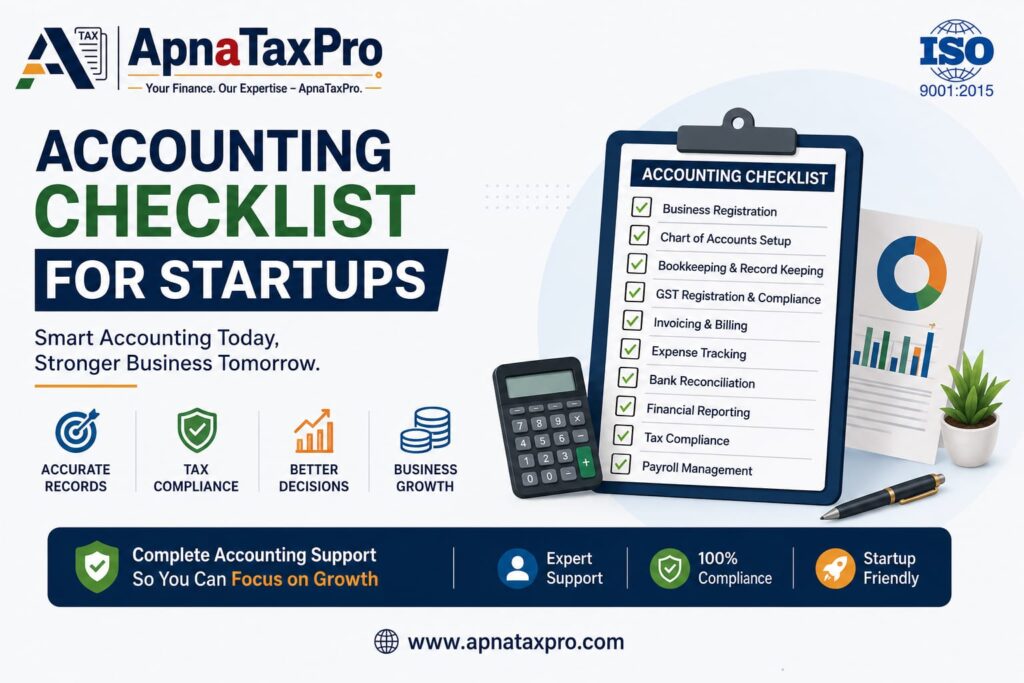
Startup Accounting Checklist
1. Register Your Business Properly
The first step is selecting the right business structure.
Common options include:
- Sole Proprietorship
- Partnership Firm
- LLP
- Private Limited Company
- One Person Company (OPC)
Choosing the right structure affects taxation, compliance, fundraising opportunities, and future expansion.
2. Open a Separate Business Bank Account
Avoid mixing personal and business transactions.
A dedicated business bank account helps:
- Maintain accurate books
- Simplify audits
- Track business expenses
- Improve financial transparency
3. Set Up an Accounting System
Choose an accounting software or professional accounting service from the beginning.
Your accounting system should record:
- Sales
- Purchases
- Business expenses
- Assets
- Liabilities
- Bank transactions
- GST
- TDS
- Payroll
Regular bookkeeping prevents year-end accounting issues.
4. Maintain Proper Bookkeeping
Bookkeeping should never be postponed.
Maintain records of:
- Sales invoices
- Purchase invoices
- Payment receipts
- Vendor bills
- Bank statements
- Expense vouchers
- Petty cash transactions
Accurate bookkeeping ensures reliable financial reporting and easier tax filing.
5. Complete GST Registration (If Applicable)
Depending on your business turnover and the nature of your services, GST registration may be mandatory.
After registration, ensure:
- GST-compliant invoices
- Input Tax Credit reconciliation
- Timely GST Return Filing
- Proper maintenance of GST records
Late filings can attract interest and penalties.
6. Track Every Business Expense
Many startups lose money simply because they fail to monitor expenses.
Common startup expenses include:
- Office rent
- Internet bills
- Employee salaries
- Freelancer payments
- Software subscriptions
- Marketing expenses
- Advertising costs
- Travel expenses
- Professional fees
Categorizing expenses correctly improves budgeting and tax planning.
7. Manage Accounts Receivable
Outstanding customer payments directly affect cash flow.
Create a system to:
- Send invoices on time
- Monitor payment due dates
- Follow up with customers
- Record collections promptly
Healthy cash flow keeps operations running smoothly.
8. Monitor Accounts Payable
Track vendor payments carefully.
Maintain records of:
- Due dates
- Payment status
- Purchase orders
- Vendor invoices
Timely payments help maintain strong supplier relationships.
9. Process Payroll Correctly
If your startup has employees, payroll should be accurate and timely.
Payroll includes:
- Salary processing
- TDS deductions
- PF & ESIC (where applicable)
- Leave records
- Employee reimbursements
A structured payroll system improves compliance and employee satisfaction.
10. Maintain TDS Compliance
Many startups are required to deduct Tax Deducted at Source (TDS) on specific payments.
Ensure:
- Correct TDS deductions
- Timely deposit
- Quarterly TDS returns
- TDS certificates
Proper compliance avoids notices and penalties.
11. Prepare Monthly Financial Reports
Every founder should review monthly reports such as:
- Profit & Loss Statement
- Balance Sheet
- Cash Flow Statement
- Accounts Receivable Report
- Accounts Payable Report
- Expense Analysis
These reports help identify financial trends before they become major issues.
12. Review Cash Flow Every Month
Profit and cash flow are not the same.
A startup can be profitable on paper but still face cash shortages due to delayed customer payments or high operating expenses.
Review:
- Opening cash balance
- Monthly collections
- Operating expenses
- Vendor payments
- Closing cash balance
13. File Income Tax Returns on Time
Timely income tax compliance helps avoid:
- Interest
- Penalties
- Notices
- Delays in business funding
Maintain accurate accounting records throughout the year to simplify return filing.
14. Maintain Supporting Documents
Keep digital copies of:
- Purchase invoices
- Sales invoices
- Bank statements
- GST returns
- Tax payment challans
- Contracts
- Employee records
- Investment documents
Good documentation supports audits and tax assessments.
15. Plan Your Business Budget
Budgeting helps startups control expenses and achieve financial goals.
Review:
- Expected revenue
- Fixed expenses
- Variable expenses
- Marketing budget
- Hiring plans
- Investment requirements
Budget reviews should be conducted every month.
Monthly Accounting Checklist for Startups
| Activity | Frequency |
|---|---|
| Update Bookkeeping | Weekly/Daily |
| Bank Reconciliation | Monthly |
| GST Return Filing | Monthly/Quarterly |
| Payroll Processing | Monthly |
| Financial Reports | Monthly |
| Cash Flow Review | Monthly |
| Expense Analysis | Monthly |
| Tax Planning | Quarterly |
| Compliance Review | Quarterly |
Common Accounting Mistakes Startups Should Avoid
- Mixing personal and business expenses
- Delaying bookkeeping
- Missing GST deadlines
- Ignoring cash flow
- Not reconciling bank accounts
- Poor invoice management
- Inadequate expense documentation
- No financial reporting
- Waiting until year-end for accounting
- Making business decisions without financial data
Why Choose ApnaTaxPro?
Managing startup finances requires accuracy, consistency, and timely compliance. At ApnaTaxPro, we help startups establish a strong financial foundation from the beginning.
Our services include:
- Accounting Services
- Bookkeeping Services
- GST Registration & Return Filing
- Income Tax Filing
- TDS Compliance
- Payroll Services
- Startup Registration
- Company Registration
- ROC Compliance
- Virtual CFO Services
- Financial Reporting
- Business Advisory
Whether you’re looking for Accounting Services in Indore, Bookkeeping Services in Indore, GST Consultant in Indore, or Tax Consultant in Indore, our team provides practical solutions tailored to startups and growing businesses.
Frequently Asked Questions
1. Why is accounting important for startups?
It helps track finances, maintain compliance, improve cash flow, and support informed decision-making.
2. When should a startup start bookkeeping?
From the very first business transaction.
3. Does every startup need GST registration?
Not always. It depends on turnover, business activity, and legal requirements.
4. How often should financial reports be reviewed?
Monthly reviews are recommended for better financial control.
5. Can startups outsource accounting?
Yes. Outsourced accounting is cost-effective and provides access to professional expertise.
6. What documents should startups maintain?
Invoices, bank statements, GST records, payroll records, tax documents, and contracts.
7. What is the benefit of a Virtual CFO?
A Virtual CFO provides financial planning, budgeting, reporting, and strategic guidance without the cost of a full-time CFO.
8. How can ApnaTaxPro help startups?
ApnaTaxPro offers end-to-end accounting, bookkeeping, GST, tax, payroll, compliance, financial reporting, and advisory services to help startups grow with confidence.
Conclusion
Strong accounting practices are one of the biggest advantages a startup can have. By following a structured accounting checklist, founders can maintain compliance, improve cash flow, reduce financial risks, and make better business decisions.
Investing in professional accounting from the beginning saves time, avoids costly mistakes, and creates a solid foundation for sustainable growth.
Call to Action
Starting a new business? Let ApnaTaxPro handle your accounting, bookkeeping, GST, tax compliance, payroll, and financial reporting while you focus on building your startup.
Contact ApnaTaxPro today to streamline your startup finances with expert accounting support.