
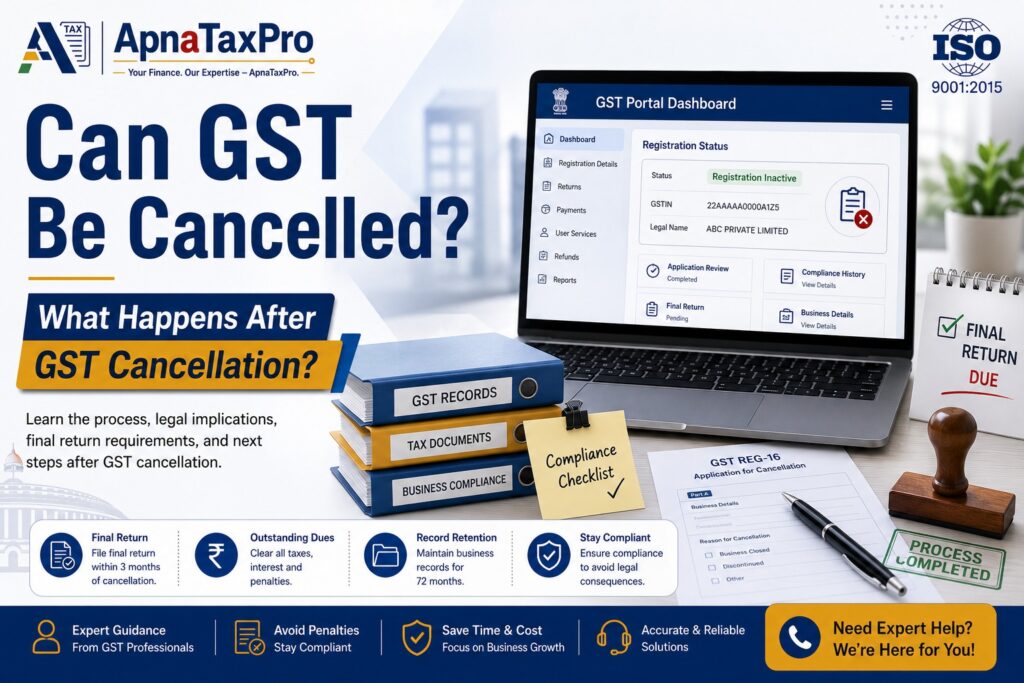
Imagine a small business owner who obtained GST Registration while starting a business. Initially, sales were growing, GST returns were filed regularly, and business operations were running smoothly. However, after a few months, the business stopped operating due to market conditions. Since there were no transactions, the owner stopped filing GST returns, assuming that inactivity meant no compliance requirements.
After some time, the business received a notice from the GST department stating that the GST Registration had been cancelled.
This situation is more common than many business owners realize.
Whether you are a startup, trader, manufacturer, freelancer, service provider, or MSME, understanding GST cancellation is essential. Many businesses are unaware of the legal and financial consequences that arise once GST Registration is cancelled.
In this guide, we will explain when GST can be cancelled, who can cancel it, what happens after cancellation, and how businesses can protect themselves from compliance risks.
What Is GST Cancellation?
GST Cancellation refers to the termination of a GST Registration issued under the Goods and Services Tax Act.
Once cancelled, the taxpayer is no longer authorized to collect GST from customers or claim Input Tax Credit (ITC).
GST cancellation may occur:
- Voluntarily by the taxpayer
- Suo moto by the GST department
- Due to business closure
- Due to business restructuring
- Due to non-compliance with GST laws
Who Can Cancel GST Registration?
1. Cancellation by the Taxpayer
A taxpayer may apply for GST cancellation when:
- Business is discontinued
- Proprietor passes away
- Business is transferred
- Business is merged or demerged
- Turnover falls below GST threshold limits
- Registration was obtained voluntarily and is no longer required
2. Cancellation by GST Department
The GST officer may cancel GST Registration if:
- GST returns are not filed continuously
- Business is found non-operational
- GST Registration was obtained fraudulently
- Incorrect information was provided during registration
- Taxpayer violates GST provisions
Common Reasons for GST Cancellation
Non-Filing of GST Returns
One of the most common reasons for GST cancellation is failure to file GST returns.
Businesses often assume that if there is no business activity, there is no need to file returns. However, NIL GST returns are still mandatory.
Business Closure
When a business permanently closes operations, GST Registration should be surrendered through proper cancellation procedures.
Voluntary Registration No Longer Required
Some businesses take GST Registration voluntarily. If turnover remains below the threshold and GST Registration is no longer beneficial, cancellation may be requested.
Fraudulent Registration
The GST department may cancel registrations obtained through false documents or misrepresentation.
What Happens After GST Cancellation?
Many business owners focus only on obtaining GST Registration but overlook the implications of cancellation.
The following consequences occur after GST cancellation:
1. You Cannot Collect GST
After cancellation:
- GST cannot be charged on invoices.
- Tax invoices cannot be issued.
- GST amount cannot be collected from customers.
Collecting GST after cancellation can attract penalties.
2. Input Tax Credit Becomes Restricted
A cancelled GST taxpayer loses eligibility to claim Input Tax Credit on future purchases.
This may increase the overall cost of doing business.
3. Business Credibility May Be Impacted
Many customers, vendors, government departments, and Nearby SMEs Companies prefer dealing with GST-registered entities.
Cancellation may impact:
- Vendor onboarding
- Tender participation
- Corporate contracts
- Business credibility
4. GST Compliance Requirements Continue
Many taxpayers are surprised to learn that cancellation does not automatically erase past compliance obligations.
Outstanding liabilities, notices, assessments, and penalties may still remain applicable.
5. Final Return Must Be Filed
After GST cancellation, taxpayers are generally required to file a final return within the prescribed timeline.
Failure to comply may attract additional penalties.
Can a Cancelled GST Registration Be Revoked?
Yes.
If GST Registration has been cancelled by the department, businesses may apply for revocation of cancellation subject to eligibility conditions.
When Revocation Is Possible
Revocation may be available when:
- Pending GST returns are filed
- Tax dues are paid
- Interest and penalties are cleared
- Compliance deficiencies are corrected
Practical Example
A service provider failed to file GST returns for several months. The GST department cancelled the registration.
The business subsequently:
- Filed pending returns
- Paid tax liabilities
- Cleared late fees
- Applied for revocation
After verification, the GST Registration was restored.
GST Cancellation vs GST Suspension
| Particulars | GST Suspension | GST Cancellation |
|---|---|---|
| Status | Temporary | Permanent |
| GST Collection | Not Allowed | Not Allowed |
| Registration Validity | Exists | Terminated |
| Revocation Possible | Yes | Subject to conditions |
| Business Operations | Restricted | Registration ceases |
Understanding the difference helps businesses take corrective action before cancellation occurs.
How Businesses Can Avoid GST Cancellation
Maintain Regular GST Compliance
Businesses should:
- File GST returns on time
- Pay GST liabilities regularly
- Respond to departmental notices
- Maintain proper Account and Records
Keep Business Information Updated
Any change in:
- Address
- Contact details
- Business constitution
- Authorized signatory
should be updated promptly on the GST portal.
Maintain Proper Accounting and Bookkeeping
Strong Accounting and Bookkeeping systems reduce compliance risks significantly.
Businesses that maintain accurate records are less likely to face GST-related issues.
Seek Professional Guidance
Working with a GST Consultant in Indore or a professional GST Filing Company can help identify compliance issues before they become serious problems.
Importance of Proper Accounting After GST Cancellation
Many businesses assume that GST cancellation ends all financial responsibilities.
However, proper Accounting, Professional Tax compliance, Account and Records management, Income Tax Filing, Payroll Services, and Financial Reporting continue to remain important.
Business owners should maintain:
- Sales records
- Purchase records
- Tax records
- Bank records
- Employee records
These records may be required during future assessments or audits.
Why Choose ApnaTaxPro?
Managing GST compliance requires more than simply filing returns. Businesses need proper Accounting, Bookkeeping, Financial Reporting, and Business Advisory support to remain compliant and financially healthy.
Apna Tax Pro helps startups, MSMEs, traders, manufacturers, freelancers, and service providers with:
- Accounting Services
- Bookkeeping Services
- GST Registration
- GST Return Filing
- GST Compliance
- Income Tax Filing
- TDS Compliance
- Payroll Services
- ROC Compliance
- Virtual CFO Services
- Financial Reporting
- Business Advisory
- Startup Registration
- Company Registration
- New Company Registration in Indore
- Gumasta Udyham Registration Support
Businesses searching for an Accountant Office Near Me, GST Consultant in Indore, Tax Consultant in Indore, Accounting Services in Indore, or Bookkeeping Services in Indore can benefit from professional compliance assistance and structured financial management.
Frequently Asked Questions (FAQs)
1. Can GST registration be cancelled voluntarily?
Yes. A taxpayer can apply for cancellation if the business is closed, transferred, or no longer requires GST registration.
2. Can GST be cancelled due to non-filing of returns?
Yes. Continuous non-filing of GST returns is one of the most common reasons for cancellation.
3. Can I continue business after GST cancellation?
You may continue business if GST registration is not legally required. However, you cannot collect GST.
4. Is a final GST return required after cancellation?
Yes. A final return is generally required after GST cancellation.
5. Can a cancelled GST registration be restored?
Yes, through revocation of cancellation, subject to eligibility and compliance requirements.
6. Will GST cancellation affect Input Tax Credit?
Yes. Future ITC claims generally become unavailable after cancellation.
7. How can I avoid GST cancellation?
File returns on time, maintain proper records, pay taxes, and respond to GST notices promptly.
8. Should I hire a GST consultant for cancellation or revocation?
Professional assistance can help ensure proper compliance and avoid unnecessary delays or penalties.
Conclusion
GST cancellation can have significant implications for businesses, including loss of GST collection rights, Input Tax Credit restrictions, and compliance obligations. Whether cancellation occurs voluntarily or through departmental action, understanding the process is essential for protecting your business interests.
Maintaining proper Accounting, Bookkeeping, GST Compliance, Account and Records management, and timely GST Return Filing can help businesses avoid unnecessary cancellations and regulatory complications.
Call to Action
Need help with GST Registration, GST Cancellation, GST Return Filing, Accounting Services, Bookkeeping, Professional Tax, Income Tax Filing, or Business Compliance?
Contact ApnaTaxPro today for expert guidance from experienced professionals. Our team helps businesses stay compliant, organized, and financially confident with reliable accounting and taxation solutions.