
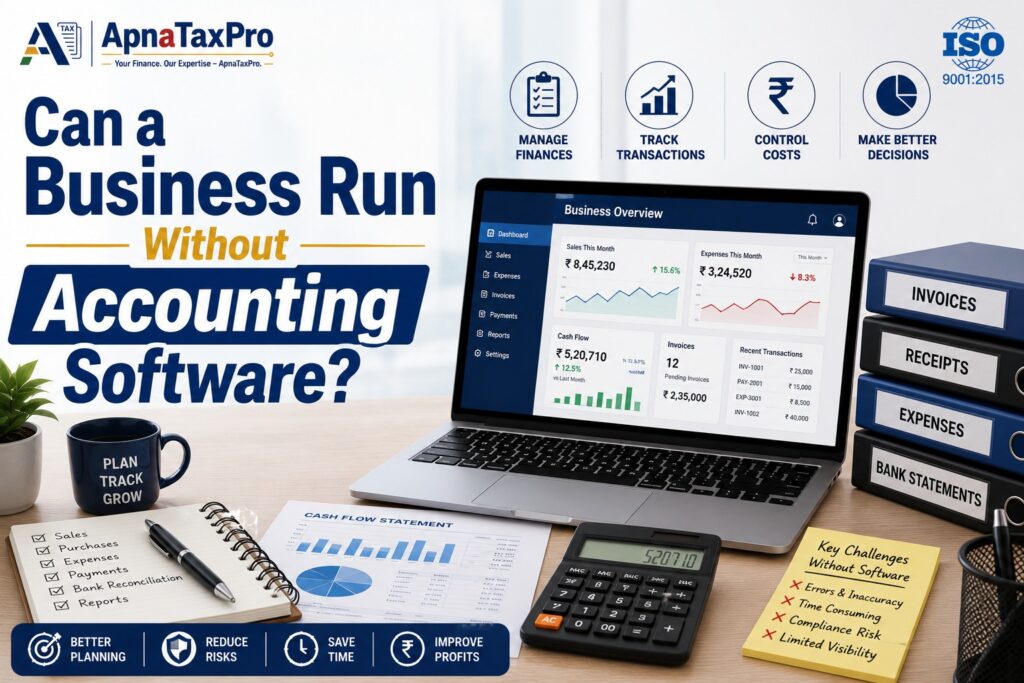
Imagine a business owner who manages sales, purchases, expenses, GST filings, and bank transactions using notebooks, spreadsheets, and memory. In the early stages of a business, this approach may appear manageable. Many traders, freelancers, service providers, and small business owners begin operations without investing in accounting software.
However, as transactions increase, managing ACCOUNTS AND RECORDS manually becomes difficult. Errors start appearing, invoices get misplaced, GST compliance becomes challenging, and business decisions are often made without reliable financial data.
This raises an important question: Can a business run without accounting software?
The simple answer is yes—but only to a certain extent. The real question is whether a business can run efficiently, accurately, and profitably without accounting software.
In this article, we explore the advantages, limitations, risks, and practical considerations of running a business without accounting software.
What Is Accounting Software?
Accounting software is a digital tool designed to record, organize, and manage financial transactions.
It helps businesses perform:
- ACCOUNTING and BOOKKEEPING
- Invoice generation
- Expense tracking
- GST calculations
- Payroll management
- Financial reporting
- Bank reconciliation
- Tax compliance
Popular examples include Tally Prime, Zoho Books, QuickBooks, and other cloud-based accounting solutions.
Can a Business Operate Without Accounting Software?
Technically, yes.
Many micro-businesses and sole proprietorships initially maintain records using:
- Physical registers
- Excel spreadsheets
- Manual cash books
- Paper invoices
For businesses with very few monthly transactions, this may work temporarily.
However, as revenue grows and compliance requirements increase, manual systems often create operational challenges.
Challenges of Running a Business Without Accounting Software
1. Increased Risk of Human Errors
Manual data entry increases the possibility of:
- Calculation mistakes
- Duplicate entries
- Missing transactions
- Incorrect GST figures
Even a small error can affect profitability and tax compliance.
2. Difficulty Managing Account and Records
Maintaining accurate ACCOUNT AND RECORDS becomes increasingly difficult when transaction volumes rise.
Business owners often struggle to locate:
- Purchase bills
- Sales invoices
- Payment records
- Tax documents
Poor record management can lead to compliance issues during audits or assessments.
3. Limited Financial Visibility
Without proper accounting systems, business owners may not know:
- Actual profits
- Outstanding receivables
- Cash flow position
- Business liabilities
This can result in poor financial decisions.
4. Compliance Risks
Businesses must comply with:
- GST Registration requirements
- GST Return Filing
- Income Tax Filing
- TDS compliance
- Professional Tax regulations
Manual systems increase the risk of late filings and incorrect reporting.
Comparison: Manual Accounting vs Accounting Software
| Factor | Manual Accounting | Accounting Software |
|---|---|---|
| Accuracy | Moderate | High |
| Time Required | High | Low |
| Reporting | Limited | Automated |
| GST Compliance | Difficult | Easier |
| Financial Analysis | Limited | Comprehensive |
| Scalability | Low | High |
| Error Detection | Difficult | Easier |
| Data Security | Moderate | Better |
The comparison clearly shows that software provides significant operational advantages.
When Can a Business Manage Without Accounting Software?
A business may temporarily operate without software if:
- Transaction volume is very low
- The owner maintains accurate records
- Compliance requirements are minimal
- The business is newly established
Examples include:
- Freelancers
- Consultants
- Small home businesses
- Single-person service providers
Even in these situations, maintaining proper BOOKKEEPING remains essential.
Signs Your Business Needs Accounting Software
Consider implementing accounting software if:
Your Transactions Are Increasing
When hundreds of transactions occur monthly, manual tracking becomes inefficient.
You Have Employees
Payroll management requires accuracy and compliance.
You File GST Returns
A GST FILLING COMPANY or GST consultant often requires organized financial records for timely filing.
You Need Financial Reports
Growth-oriented businesses need:
- Profit and Loss Statements
- Balance Sheets
- Cash Flow Reports
- Management Reports
You Are Seeking Funding
Banks and investors typically request structured financial statements.
How Accounting Software Supports Business Growth
Better Cash Flow Management
Software helps track:
- Receivables
- Payables
- Due dates
- Bank balances
Faster Decision-Making
Business owners gain access to real-time financial information.
Improved Compliance
GST, TDS, and Income Tax obligations become easier to manage.
Business Scalability
Growing businesses require systems that support expansion.
This is especially important for startups and NEW COMPANY REGISTRATION IN INDORE projects planning long-term growth.
Accounting Software Is Not a Replacement for Professional Expertise
Many business owners believe purchasing software eliminates the need for professional support.
This is not true.
Software records data, but professionals interpret it.
An experienced accounting team can help with:
- Tax planning
- Financial reporting
- Business compliance
- GST advisory
- Payroll management
- Strategic decision-making
This is why many businesses combine software with outsourced accounting services.
The Role of Professional Accounting Services
Professional ACCOUNTING Services provide more than data entry.
They help businesses:
Maintain Accurate Books
Proper BOOKKEEPING ensures financial accuracy.
Ensure Compliance
Timely filings reduce penalties and notices.
Generate Financial Reports
Reliable reports support business decisions.
Improve Profitability
Financial analysis helps identify opportunities and inefficiencies.
For many SMEs and startups, outsourced ACCOUNTING AND financial management services are more cost-effective than maintaining a full in-house team.
Why Local Businesses in Indore Are Adopting Accounting Technology
Businesses across Indore are increasingly adopting accounting software because of:
- Growing compliance requirements
- GST obligations
- Increased competition
- Demand for real-time reporting
Whether you operate a trading business, manufacturing unit, startup, or service company, technology improves financial management.
Many nearby SMEs companies are shifting from manual bookkeeping to digital accounting systems to improve efficiency and transparency.
How ApnaTaxPro Supports Businesses
APNA TAX PRO helps businesses establish efficient accounting and compliance systems that support growth.
Our services include:
- Accounting Services
- Bookkeeping Services
- GST Registration
- GST Return Filing
- Income Tax Filing
- Professional Tax Compliance
- Payroll Services
- Business Registration
- ROC Compliance
- Virtual CFO Services
- Financial Reporting
- Business Advisory
Whether you are looking for an ACCOUNTANT OFFICE NEAR ME, starting a new venture, managing GUMASTA UDHYAM registration requirements, or seeking support for NEW COMPANY REGISTRATION IN INDORE, APNATAXPRO provides practical solutions tailored to your business needs.
Our team helps businesses implement structured accounting processes while ensuring compliance with applicable regulations.
Frequently Asked Questions
1. Can a small business run without accounting software?
Yes, but only when transaction volumes are very low. As businesses grow, software becomes increasingly beneficial.
2. Is Excel enough for accounting?
Excel can work for basic record keeping, but it lacks automation, compliance features, and reporting capabilities.
3. What are the risks of manual accounting?
Common risks include calculation errors, missing records, compliance issues, and inaccurate financial reporting.
4. Does accounting software help with GST?
Yes. Most accounting software solutions simplify GST calculations, invoicing, and GST Return Filing.
5. Is accounting software mandatory in India?
No. However, businesses must maintain accurate books and records regardless of the method used.
6. Can accounting software replace an accountant?
No. Software automates processes, but professional accountants provide expertise, analysis, and compliance support.
7. Which businesses benefit most from accounting software?
Startups, SMEs, manufacturers, traders, and service providers typically gain significant benefits.
8. Should a startup invest in accounting software from day one?
In many cases, yes. Early adoption helps establish organized financial processes and supports future growth.
Conclusion
A business can operate without accounting software, but doing so becomes increasingly difficult as transactions, compliance requirements, and operational complexity grow.
Manual systems may work temporarily for very small businesses. However, accounting software improves accuracy, efficiency, compliance, reporting, and decision-making.
Businesses that invest in proper ACCOUNTING, BOOKKEEPING, and financial management systems are generally better positioned for sustainable growth.
Call to Action
Looking for reliable Accounting Services in Indore, Bookkeeping Services in Indore, GST Registration, GST Return Filing, Virtual CFO Services, or Business Compliance support?
Contact APNATAXPRO today and discover how professional accounting solutions can help your business stay compliant, organized, and growth-ready.