
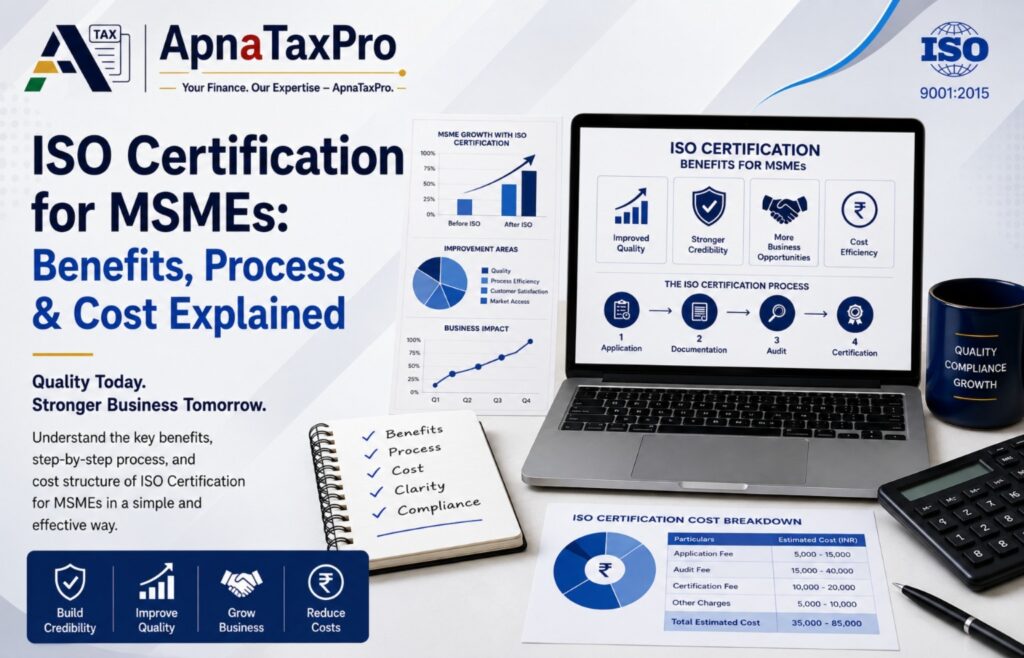
Many MSME owners focus on increasing sales, managing expenses, maintaining ACCOUNTING records, and complying with GST REGISTRATION requirements. However, when they approach larger customers, government tenders, exporters, or corporate buyers, they often face one common challenge—credibility.
Buyers want assurance that the business follows standard processes and quality practices. This is where ISO Certification becomes valuable.
Whether you are a manufacturer, trader, service provider, startup, or one of the growing NEARBY SMES COMPANIES in your region, ISO Certification can help improve trust, operational efficiency, and business opportunities.
In this guide, we explain the benefits, process, documents required, and cost of ISO Certification for MSMEs in simple language.
What is ISO Certification?
ISO (International Organization for Standardization) develops globally recognized standards that help businesses maintain quality, consistency, efficiency, and customer satisfaction.
ISO Certification confirms that a business follows specific management and operational standards.
Some common ISO standards include:
| ISO Standard | Purpose |
|---|---|
| ISO 9001 | Quality Management System |
| ISO 14001 | Environmental Management |
| ISO 27001 | Information Security |
| ISO 22000 | Food Safety Management |
| ISO 45001 | Occupational Health & Safety |
Among MSMEs, ISO 9001 is the most commonly adopted certification.
Why ISO Certification is Important for MSMEs
Many small businesses believe ISO Certification is only for large corporations. In reality, MSMEs often benefit more because certification helps them compete with larger businesses.
Key advantages include:
1. Improved Business Credibility
Customers and corporate buyers are more likely to trust businesses that follow internationally recognized standards.
2. Better Customer Satisfaction
Documented procedures reduce errors and improve consistency in products and services.
3. Increased Business Opportunities
Many tenders, vendor registrations, and corporate procurement processes prefer or require ISO-certified vendors.
4. Stronger Internal Processes
ISO encourages businesses to maintain proper ACCOUNT AND RECORDS, documentation, and process controls.
5. Competitive Advantage
Certification differentiates your business from competitors and enhances brand reputation.
Major Benefits of ISO Certification for MSMEs
Enhanced Quality Control
ISO standards help businesses establish clear procedures, reducing defects and operational mistakes.
Better Operational Efficiency
Businesses can identify process gaps, improve workflow, and reduce wastage.
Improved Financial Management
When combined with proper BOOKKEEPING, ACCOUNTING, and financial reporting practices, ISO systems create stronger business controls.
Easier Access to Corporate Clients
Large organizations often prefer working with certified vendors.
Support for Business Expansion
Whether planning exports, startup growth, or NEW COMPANY REGISTRATION IN INDORE, ISO certification can strengthen business credibility.
Who Should Apply for ISO Certification?
ISO Certification is suitable for:
- Manufacturers
- Traders
- Service providers
- Startups
- Freelancers
- Consultants
- Exporters
- Educational institutions
- Healthcare providers
- MSMEs
- Private Limited Companies
- LLPs
Even businesses completing GST REGISTRATION, GUMASTA UDHYAM registration, or company incorporation can benefit from certification.
ISO Certification Process for MSMEs
Step 1: Select the Appropriate ISO Standard
Choose the standard based on your business activity.
For example:
- ISO 9001 for quality management
- ISO 27001 for IT and data security
- ISO 22000 for food businesses
Step 2: Gap Analysis
Review existing systems and identify areas requiring improvement.
Step 3: Documentation
Prepare:
- Policies
- Standard Operating Procedures
- Process manuals
- Quality objectives
Step 4: Implementation
Apply documented procedures throughout the organization.
Step 5: Internal Audit
Conduct internal reviews to ensure compliance.
Step 6: Certification Audit
An accredited certification body performs an audit.
Step 7: Certification Approval
Upon successful audit completion, the ISO certificate is issued.
Documents Required for ISO Certification
Typically, businesses need:
- PAN Card
- Aadhaar Card
- GST Registration Certificate
- MSME/Udyam Registration
- Business Address Proof
- Business Registration Documents
- Bank Details
- Business Profile
- Scope of Activities
Document requirements may vary depending on the selected ISO standard.
How Much Does ISO Certification Cost?
The cost depends on several factors:
- Business size
- Number of employees
- Type of ISO standard
- Number of business locations
- Complexity of operations
- Certification body selected
Approximate Cost Range
| Business Type | Estimated Cost |
| Small Business | ₹5,000 – ₹25,000 |
| MSME | ₹10,000 – ₹50,000 |
| Medium Enterprise | ₹25,000 – ₹1,00,000+ |
Businesses should focus on quality certification and proper implementation rather than selecting the lowest-cost option.
Common Mistakes MSMEs Should Avoid
Choosing Certification Only for Marketing
The objective should be process improvement, not merely obtaining a certificate.
Ignoring Documentation
Proper ACCOUNT AND RECORDS management is essential for successful certification.
Selecting the Wrong ISO Standard
Choose a certification aligned with business activities.
Not Training Employees
Staff awareness is critical for successful implementation.
Working Without Professional Guidance
An experienced consultant can simplify the process and reduce delays.
How ISO Certification Supports Business Growth
ISO Certification works best when combined with strong compliance and financial management systems.
Businesses that maintain:
- Proper ACCOUNTING
- Accurate BOOKKEEPING
- GST Return Filing
- Payroll Services
- Income Tax Filing
- Business Compliance
- Financial Reporting
often experience smoother growth and better operational control.
This is particularly important for businesses seeking investors, corporate clients, and government opportunities.
Why Choose ApnaTaxPro?
APNA TAX PRO helps startups, MSMEs, traders, manufacturers, and service businesses manage both compliance and growth requirements under one roof.
Our services include:
- Accounting Services in Indore
- Bookkeeping Services in Indore
- GST Consultant in Indore
- Tax Consultant in Indore
- GST Return Filing
- GST REGISTRATION
- Income Tax Filing
- PROFESSINAL TAX Compliance Support
- Payroll Services
- ROC Compliance
- MSME Registration
- GUMASTA UDHYAM Registration
- Company Registration
- NEW COMPANY REGISTRATION IN INDORE
- Virtual CFO Services
- Business Advisory
- Financial Reporting
- Outsourced Accounting
- Online Accounting
Whether you are searching for an ACCOUNTANT OFFICE NEAR ME, a GST FILLING COMPANY, or a trusted MSME Consultant, ApnaTaxPro helps businesses maintain compliance while focusing on growth.
Frequently Asked Questions (FAQs)
1. Is ISO Certification mandatory for MSMEs?
No. ISO Certification is generally voluntary but can be beneficial for credibility and business growth.
2. Which ISO standard is best for MSMEs?
ISO 9001 is the most commonly recommended certification for quality management.
3. How long does ISO Certification take?
Typically between 7 days and several weeks depending on business readiness and certification requirements.
4. Can startups apply for ISO Certification?
Yes. Startups can obtain ISO Certification and improve credibility from an early stage.
5. Is GST Registration required for ISO Certification?
Not always, but many certification agencies request business registration documents.
6. Does ISO Certification help in government tenders?
Yes. Many tenders give preference to ISO-certified businesses.
7. What is the validity of ISO Certification?
Generally, certification remains valid for three years subject to surveillance audits.
8. Can service businesses obtain ISO Certification?
Yes. Service providers, consultants, IT companies, educational institutions, and healthcare organizations can all obtain certification.
Conclusion
ISO Certification is more than a compliance document. It is a structured framework that helps MSMEs improve quality, customer satisfaction, operational efficiency, and business credibility.
Whether you are a startup, manufacturer, trader, or service provider, ISO Certification can strengthen your market position and support long-term growth. When combined with proper ACCOUNTING, BOOKKEEPING, GST compliance, and financial reporting, it becomes a valuable business asset.
Call to Action
Looking to obtain ISO Certification for your business?
ApnaTaxPro provides end-to-end assistance with ISO Certification, GST Registration, MSME Registration, Accounting Services, Tax Compliance, and Business Advisory. Contact our team today to discuss the most suitable certification for your business and take the next step toward sustainable growth.