
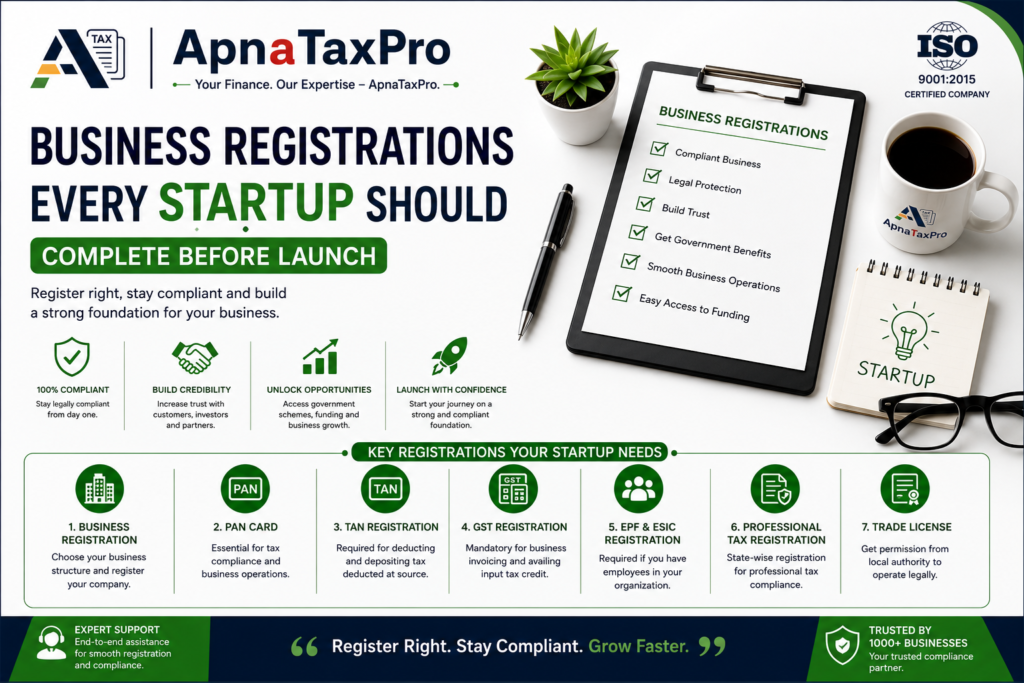
Starting a business is an exciting milestone, but launching without completing the required legal registrations can create unnecessary challenges. Many entrepreneurs focus on developing their product, attracting customers, or building a website, while important compliance requirements are left until later. This often results in delays, penalties, difficulties in opening business bank accounts, or missed opportunities when applying for government schemes and business loans.
Whether you are launching a trading business, manufacturing unit, consultancy, IT startup, retail store, or service-based company, completing the right business registrations before operations begin helps establish credibility and ensures smoother business growth.
Proper registrations also simplify ACCOUNTING, BOOKKEEPING, maintaining ACCOUNT AND RECORDS, taxation, and regulatory compliance. They create a strong legal foundation that supports future expansion, funding opportunities, and long-term financial stability.
If you are searching for an ACCOUNTANT OFFICE NEAR ME or planning a NEW COMPANY REGISTRATION IN INDORE, understanding these registrations will help you make informed decisions from the beginning.
In this comprehensive guide, we explain the most important registrations every startup should complete before launch and why each one matters.
Why Business Registrations Are Important Before Launch
Registering your business is much more than completing paperwork. It establishes your business as a legally recognized entity and allows you to operate confidently in today’s competitive environment.
A properly registered business can:
- Build trust with customers and suppliers
- Open current bank accounts easily
- Apply for business loans
- Participate in government tenders
- Claim eligible tax benefits
- Issue GST invoices where applicable
- Maintain proper financial records
- Avoid unnecessary legal disputes
- Improve investor confidence
Businesses that complete registrations early generally find it easier to scale because their legal and financial systems are already in place.
Essential Business Registrations Every Startup Should Complete
1. Choose the Right Business Structure
The first and most important decision is selecting the appropriate legal structure. This affects taxation, compliance requirements, liability, funding opportunities, and future expansion.
Common business structures include:
| Business Type | Suitable For | Key Advantage |
|---|---|---|
| Proprietorship | Small businesses | Easy to start |
| Partnership Firm | Two or more owners | Simple management |
| LLP | Professional firms and startups | Limited liability |
| Private Limited Company | Growth-focused startups | Better funding opportunities |
| One Person Company (OPC) | Solo entrepreneurs | Separate legal identity |
Selecting the wrong structure can lead to higher compliance costs or difficulties in raising capital later. It is advisable to evaluate your business goals before registration.
2. Company Registration
If you plan to build a scalable business, hire employees, raise investment, or establish a professional corporate identity, Company Registration is an important step.
Depending on your business model, this may involve registering as:
- Private Limited Company
- LLP
- One Person Company
- Partnership Firm
- Sole Proprietorship
Benefits include:
- Legal recognition
- Separate business identity
- Limited liability protection
- Improved brand reputation
- Easier access to funding
- Better opportunities with corporate clients
Entrepreneurs planning NEW COMPANY REGISTRATION IN INDORE should also ensure that their chosen business name, registered office, and required documentation are prepared before starting the registration process.
3. PAN and TAN Registration
Every registered business should obtain a Permanent Account Number (PAN). Businesses responsible for deducting Tax Deducted at Source (TDS) must also obtain a Tax Deduction and Collection Account Number (TAN).
PAN is required for:
- Opening bank accounts
- Filing income tax returns
- Financial transactions
- Business compliance
TAN is required for:
- Deducting TDS
- Depositing TDS
- Filing TDS returns
- Employee salary compliance
Without these registrations, routine financial operations may become difficult.
4. GST Registration
One of the most important registrations for growing businesses is GST REGISTRATION.
Businesses crossing the prescribed turnover threshold or those involved in interstate supply, e-commerce, or specific notified activities may be required to obtain GST registration.
Benefits include:
- Legally issue GST invoices
- Claim Input Tax Credit
- Increase business credibility
- Work with larger companies
- Expand across multiple states
Many startups also prefer voluntary GST registration because corporate customers often prefer dealing with GST-registered vendors.
Working with an experienced GST FILLING COMPANY can help businesses manage registration, return filing, reconciliations, and ongoing compliance more efficiently.
5. MSME (Udyam) Registration
Although not mandatory for every business, GUMASTA UDHYAM (commonly referring to local shop establishment licensing alongside Udyam Registration, depending on the state) and Udyam Registration provide several advantages for eligible Micro, Small, and Medium Enterprises (MSMEs).
Key benefits include:
- Easier access to government schemes
- Priority sector lending
- Lower interest rates on eligible loans
- Protection against delayed payments
- Subsidies under applicable government programs
- Better eligibility for tenders
Many startups overlook Udyam Registration during the initial phase, only to realize its value when applying for finance or government support. Completing this registration early can strengthen your business position as it grows.
6. Shop & Establishment (Gumasta) Registration
Depending on your state and the nature of your business, you may also need a Shop & Establishment Registration, often referred to as a Gumasta License in some regions.
This registration generally helps regulate:
- Working hours
- Employee records
- Business premises
- Employment conditions
- Local business compliance
For startups operating from offices, retail outlets, or commercial establishments, obtaining this registration can be an important part of overall compliance.
Build a Strong Compliance Foundation from Day One
Completing registrations at the beginning of your entrepreneurial journey helps reduce future compliance issues and supports sustainable business growth. Along with legal registrations, startups should also establish systems for ACCOUNTING, BOOKKEEPING, maintaining accurate ACCOUNT AND RECORDS, and timely tax compliance.
Whether you are planning a NEW COMPANY REGISTRATION IN INDORE, searching for an ACCOUNTANT OFFICE NEAR ME, or exploring opportunities among NEARBY SMES COMPANIES, having a well-structured compliance framework gives your business a professional edge from day one.
Additional Business Registrations Every Startup Should Consider
While the registrations covered in Part 1 form the foundation of a legally compliant business, several additional registrations may be required depending on your industry, business activities, and future growth plans. Completing these registrations at the right time helps reduce compliance risks and supports long-term expansion.
7. Professional Tax Registration
PROFESSIONAL TAX is a state-level tax levied by certain state governments on individuals earning income through employment, professions, trades, or businesses. The applicability, rates, and registration requirements vary by state.
Businesses employing staff in states where Professional Tax is applicable are generally required to:
- Register under the applicable state Professional Tax law.
- Deduct Professional Tax from eligible employees’ salaries where required.
- Deposit the tax with the state government within the prescribed timelines.
- File periodic returns, if applicable.
Benefits of Timely Professional Tax Compliance
- Helps avoid penalties and interest.
- Supports smooth payroll processing.
- Demonstrates good compliance practices.
- Builds credibility during audits and due diligence.
Startups planning to hire employees should verify the Professional Tax requirements in their state before commencing payroll operations.
8. Import Export Code (IEC)
Businesses intending to import goods into India or export products or services outside India generally require an Import Export Code (IEC).
An IEC is commonly required for:
- Importing raw materials
- Exporting manufactured products
- International e-commerce
- Global consulting and software services
- Receiving export incentives where applicable
Why an IEC Matters
- Enables international trade.
- Simplifies customs procedures.
- Supports business expansion into overseas markets.
- Required by many logistics and customs processes.
Even startups with future international plans should understand the importance of obtaining an IEC before beginning cross-border operations.
9. FSSAI Registration (For Food Businesses)
If your startup deals with food manufacturing, food processing, restaurants, cloud kitchens, catering, food delivery, or packaged food products, FSSAI Registration or License may be required.
Typical businesses requiring FSSAI include:
- Restaurants
- Cafés
- Bakeries
- Home-based food businesses
- Cloud kitchens
- Food manufacturers
- Food distributors
Advantages
- Demonstrates compliance with food safety regulations.
- Builds customer confidence.
- Supports partnerships with food delivery platforms.
- Facilitates business expansion.
10. Trademark Registration
A startup invests significant effort in building its brand. Protecting that brand should be a priority.
Trademark Registration helps safeguard:
- Business name
- Brand logo
- Product names
- Taglines
- Brand identity
Benefits
- Exclusive rights to use the registered trademark.
- Legal protection against unauthorized use.
- Enhanced brand value.
- Greater confidence among customers and investors.
Registering a trademark early can help avoid disputes and strengthen your business identity as you grow.
11. Startup India Registration
Eligible startups can consider registering under the Startup India initiative to access various government-supported benefits.
Potential advantages may include:
- Recognition under the Startup India program.
- Access to eligible government schemes.
- Networking and mentorship opportunities.
- Participation in innovation programs.
- Easier access to certain funding initiatives.
Eligibility depends on the applicable criteria notified by the Government of India.
12. Labour Law Registrations (EPF & ESIC)
As your workforce grows, additional labour law registrations may become applicable.
Employees’ Provident Fund (EPF)
EPF helps employees build long-term retirement savings through contributions by both employer and employee, subject to applicable legal provisions.
Employees’ State Insurance (ESIC)
ESIC provides eligible employees with specified medical and social security benefits in accordance with applicable laws.
Timely registration and compliance help businesses:
- Meet statutory obligations.
- Improve employee confidence.
- Avoid notices and penalties.
- Support organized business growth.
Business Registration Comparison
| Registration | Mandatory | Suitable For | Primary Purpose |
|---|---|---|---|
| Company/LLP Registration | Yes (if chosen structure) | Startups & Companies | Legal business entity |
| PAN | Yes | All businesses | Income tax compliance |
| TAN | When applicable | Businesses deducting TDS | TDS compliance |
| GST Registration | When applicable | Goods & Service businesses | GST compliance |
| Udyam Registration | Optional | MSMEs | Government benefits |
| Shop & Establishment | State-specific | Commercial establishments | Local labour compliance |
| Professional Tax | State-specific | Employers & Professionals | State tax compliance |
| IEC | When applicable | Importers & Exporters | International trade |
| FSSAI | When applicable | Food businesses | Food safety compliance |
| Trademark | Optional | Brand owners | Brand protection |
| Startup India | Optional | Eligible startups | Startup recognition |
| EPF & ESIC | When applicable | Employers | Employee welfare compliance |
Common Mistakes Startups Should Avoid
Many startups encounter avoidable compliance issues during their early stages. Some of the most common mistakes include:
- Starting business operations before completing required registrations.
- Delaying GST Registration despite legal applicability.
- Not maintaining proper ACCOUNT AND RECORDS from the beginning.
- Ignoring BOOKKEEPING, resulting in inaccurate financial information.
- Choosing an unsuitable business structure without evaluating future plans.
- Missing statutory filing deadlines.
- Operating without required state or industry-specific licenses.
- Delaying trademark registration until after brand recognition.
- Assuming every registration is mandatory without understanding the applicable legal requirements.
Addressing these areas early helps reduce future compliance challenges and supports sustainable business growth.
Why Choose APNA TAX PRO ?
Launching a business involves more than obtaining registrations. Ongoing compliance, financial management, and strategic planning are equally important.
APNA TAX PRO provides end-to-end business support designed to help startups and growing businesses stay compliant and make informed financial decisions.
Our services include:
- ACCOUNTING Services
- BOOKKEEPING Services
- Maintenance of ACCOUNT AND RECORDS
- GST Registration and GST Return Filing
- Income Tax Filing
- TDS Compliance
- Payroll Services
- PROFESSIONAL TAX Compliance (where applicable)
- Company Registration
- LLP Registration
- Partnership Registration
- Proprietorship Registration
- MSME (Udyam) Registration
- Shop & Establishment Registration
- Trademark Assistance
- ROC Compliance
- Virtual CFO Services
- Financial Reporting
- Business Advisory
Whether you are planning a NEW COMPANY REGISTRATION IN INDORE, searching for reliable Accounting Services in Indore, looking for Bookkeeping Services in Indore, or seeking a trusted GST Consultant in Indore or Tax Consultant in Indore, professional guidance can help simplify your compliance journey.
Conclusion
A successful startup begins with a strong legal and financial foundation. Completing the appropriate business registrations before launch helps minimize compliance risks, improve operational efficiency, and enhance credibility with customers, financial institutions, and business partners.
The registrations required for your business will depend on factors such as your legal structure, industry, location, employee strength, and business activities. Reviewing these requirements early allows entrepreneurs to focus on growth rather than resolving avoidable compliance issues later.
In addition to registrations, maintaining accurate accounting records, following sound bookkeeping practices, filing taxes on time, and monitoring regulatory obligations are essential for long-term business success.
Call to Action
Planning to start your business?
Let APNATAXPRO help you choose the right business structure and complete your registrations with confidence. Our team supports startups and MSMEs with business registration, GST compliance, accounting, bookkeeping, tax filing, payroll, ROC compliance, Virtual CFO services, and ongoing business advisory—so you can focus on building your business while staying compliant.
Frequently Asked Questions (FAQs)
1. Which business registration is required before starting a startup?
The required registrations depend on your business structure and activities. Common registrations include Company or LLP Registration, PAN, GST Registration (where applicable), Udyam Registration (optional), and any industry-specific licenses required by law.
2. Is GST Registration mandatory for every startup?
No. GST Registration is mandatory only when a business meets the conditions prescribed under GST law, such as turnover thresholds or specified business activities.
3. What is the benefit of Udyam Registration?
Udyam Registration helps eligible MSMEs access government schemes, financial support, and other benefits available under applicable policies.
4. Is Professional Tax applicable in every state?
No. Professional Tax is governed by individual states. Businesses should verify the requirements applicable in the state where they operate.
5. When should a startup apply for Trademark Registration?
Applying early helps protect the business name and brand identity before the business becomes well known.
6. Why is bookkeeping important for startups?
Proper bookkeeping supports financial reporting, tax compliance, informed decision-making, and effective cash flow management.
7. What documents are commonly required for company registration?
Requirements vary by business structure, but typically include identity proof, address proof, registered office details, and other documents specified by the relevant authorities.
8. Can one firm handle all startup compliance requirements?
Yes. Many professional firms provide integrated support for business registration, accounting, bookkeeping, GST, income tax, payroll, ROC compliance, and business advisory, making compliance management more efficient.