
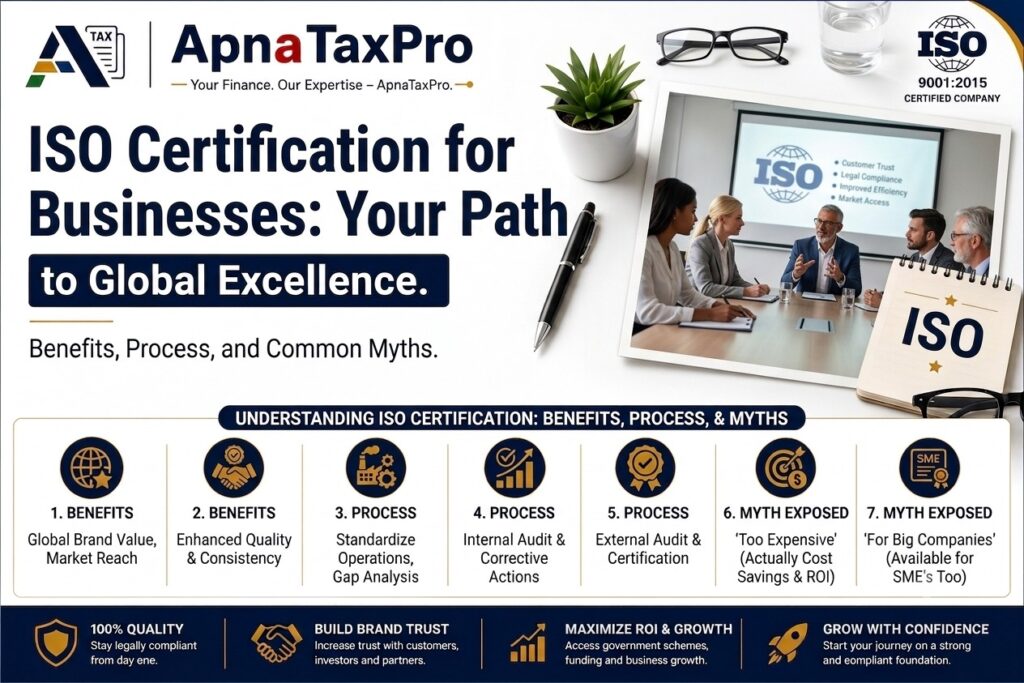
Imagine two companies offering almost identical products at similar prices. One prominently displays an internationally recognized ISO Certification, while the other has no formal quality certification. For many customers, suppliers, banks, and corporate buyers, the certified business often inspires greater confidence.
This doesn’t mean ISO Certification guarantees better products or services. Instead, it demonstrates that the business follows documented processes, focuses on continual improvement, and is committed to meeting recognized standards.
Whether you’re launching a startup, running an MSME, managing a manufacturing unit, or providing professional services, ISO Certification can strengthen your business reputation and improve operational efficiency.
Many business owners mistakenly believe that ISO Certification is only for large corporations. In reality, startups, traders, service providers, consultants, and small manufacturers can also benefit significantly from implementing the right ISO standard.
In this guide, you’ll learn:
- What ISO Certification means
- Key business benefits
- Step-by-step certification process
- Common misconceptions
- How proper ACCOUNTING, BOOKKEEPING, ACCOUNT AND RECORDS, GST REGISTRATION, and business compliance support successful certification
What is ISO Certification?
ISO (International Organization for Standardization) develops globally recognized standards that help organizations improve quality, efficiency, safety, environmental responsibility, and customer satisfaction.
An ISO Certification is issued by an accredited certification body after evaluating whether a business complies with the requirements of a particular ISO standard.
Rather than certifying individual products, ISO Certification evaluates the organization’s management systems and operational processes.
Some commonly adopted standards include:
| ISO Standard | Purpose | Suitable For |
|---|---|---|
| ISO 9001 | Quality Management System | All businesses |
| ISO 14001 | Environmental Management | Manufacturing & industries |
| ISO 45001 | Occupational Health & Safety | Factories & construction |
| ISO 27001 | Information Security | IT companies & service providers |
| ISO 22000 | Food Safety Management | Food manufacturers |
Choosing the appropriate standard depends on the nature of your business, industry requirements, and customer expectations.
Why ISO Certification Matters for Modern Businesses
Today’s customers evaluate more than just price. They look for consistency, reliability, documented processes, and long-term business stability.
ISO Certification supports these expectations by encouraging businesses to establish systematic procedures instead of relying solely on individual experience.
Some practical outcomes include:
- Better operational control
- Improved customer confidence
- Standardized documentation
- Reduced process errors
- Better compliance management
- Continuous improvement culture
- Enhanced credibility during tenders and vendor registrations
Businesses with organized ACCOUNT AND RECORDS, structured BOOKKEEPING, and reliable ACCOUNTING systems often find it easier to implement ISO standards because many documentation practices are already in place.
Major Benefits of ISO Certification
1. Builds Customer Trust
Customers prefer businesses that demonstrate commitment to quality.
ISO Certification shows that your organization follows defined procedures and regularly reviews its processes.
This is particularly valuable when dealing with:
- Corporate clients
- Government departments
- Export buyers
- Institutional customers
- Large procurement teams
2. Improves Internal Processes
Many businesses operate with undocumented procedures that depend heavily on individual employees.
ISO implementation encourages organizations to:
- Document workflows
- Define responsibilities
- Standardize approvals
- Monitor performance
- Reduce operational inefficiencies
As a result, businesses become less dependent on specific individuals and more process-driven.
3. Better Documentation and Record Management
One of the most overlooked advantages of ISO Certification is improved documentation.
Maintaining accurate ACCOUNT AND RECORDS is essential not only for ISO audits but also for regulatory compliance and informed decision-making.
Businesses should regularly maintain:
- Financial records
- Purchase records
- Sales invoices
- Employee files
- Vendor agreements
- Compliance documents
- SOPs (Standard Operating Procedures)
- Internal audit reports
Strong documentation also supports GST REGISTRATION, Professional Tax compliance, payroll management, and financial reporting.
4. Enhances Business Reputation
An ISO-certified organization is often perceived as more organized and reliable.
This can help when:
- Applying for vendor registration
- Participating in tenders
- Expanding into new markets
- Building partnerships
- Approaching financial institutions
While certification alone doesn’t guarantee contracts or funding, it can strengthen your overall business profile.
5. Supports Business Growth
As businesses expand, operations become more complex.
ISO Certification promotes scalable systems that help manage growth effectively by emphasizing:
- Defined responsibilities
- Process consistency
- Risk identification
- Corrective actions
- Ongoing performance reviews
These practices complement services such as Virtual CFO Services, financial reporting, and business advisory.
ISO Certification vs. Businesses Without ISO
| Feature | ISO Certified Business | Non-Certified Business |
|---|---|---|
| Documented Processes | Yes | Often Limited |
| Standard Operating Procedures | Yes | May Vary |
| Customer Confidence | Higher | Depends on Reputation |
| Process Monitoring | Regular | Inconsistent |
| Continuous Improvement | Structured | Informal |
| Internal Audits | Conducted | Rare |
| Operational Consistency | Better | May Depend on Individuals |
Practical Business Scenario
Consider a growing trading company that experiences frequent delays because invoices, purchase records, and operational documents are stored inconsistently across different employees.
By implementing structured documentation practices, improving BOOKKEEPING, maintaining accurate ACCOUNTING, and standardizing internal processes as part of ISO implementation, the company can reduce errors, improve coordination, and prepare more effectively for customer or certification audits.
These improvements also make it easier to manage ongoing compliance activities such as GST Registration, Professional Tax, payroll, and other statutory obligations.
Step-by-Step ISO Certification Process
Obtaining ISO Certification is not just about passing an audit. It is about building a management system that helps your business operate efficiently and consistently. While the exact process may vary depending on the ISO standard, most certifications follow these common steps.
Step 1: Identify the Appropriate ISO Standard
Start by determining which ISO standard best suits your business objectives.
For example:
- ISO 9001 – Quality Management System
- ISO 14001 – Environmental Management
- ISO 45001 – Occupational Health & Safety
- ISO 27001 – Information Security
- ISO 22000 – Food Safety Management
A manufacturing company may require a different standard than an IT firm or a consulting business.
Step 2: Conduct a Gap Analysis
A gap analysis compares your existing business processes with ISO requirements.
This helps identify:
- Missing documentation
- Process weaknesses
- Compliance gaps
- Areas requiring improvement
- Training requirements
Businesses with organized ACCOUNTING, BOOKKEEPING, and ACCOUNT AND RECORDS usually complete this stage more efficiently because much of the required documentation is already maintained.
Step 3: Prepare Documentation
Documentation forms the foundation of every ISO management system.
Typical documents include:
- Quality Manual
- Standard Operating Procedures (SOPs)
- Organization Structure
- Risk Assessment
- Process Flow Charts
- Internal Policies
- Employee Responsibilities
- Training Records
- Vendor Evaluation Records
- Customer Complaint Register
- Corrective Action Register
Financial documents such as purchase records, invoices, payroll records, and statutory registers should also be maintained accurately.
Step 4: Implement the Management System
Once documentation is ready, the organization begins following the documented procedures in day-to-day operations.
This stage often includes:
- Employee training
- Process monitoring
- Record maintenance
- Management reviews
- Performance tracking
Consistency is essential because auditors evaluate whether documented procedures are actually being followed.
Step 5: Internal Audit
Before applying for certification, businesses should conduct an internal audit.
The objective is to verify whether:
- Employees understand the procedures.
- Documentation is complete.
- Records are properly maintained.
- Non-conformities are identified.
- Corrective actions are implemented.
Internal audits help organizations prepare confidently for the certification audit.
Step 6: Certification Audit
An accredited certification body conducts the external audit.
Generally, the audit is completed in two stages:
Stage 1 Audit
The auditor reviews:
- Documentation
- Policies
- Scope of certification
- Preparedness for implementation
Stage 2 Audit
The auditor verifies:
- Actual implementation
- Employee awareness
- Process effectiveness
- Compliance with ISO requirements
- Business records and evidence
If requirements are met, the certification body issues the ISO Certificate.
Step 7: Surveillance Audits
Certification is not a one-time activity.
Most ISO certifications require periodic surveillance audits to ensure that the management system continues to operate effectively and that continual improvement is maintained.
Documents Required for ISO Certification
Although documentation requirements vary by standard, businesses commonly need:
Business Documents
- PAN Card
- GST Registration Certificate
- Business Registration Certificate
- Udyam Registration (if applicable)
- Gumasta License (where applicable)
- Company Incorporation Documents
- Partnership Deed or LLP Agreement
Operational Documents
- Organization Chart
- SOPs
- Quality Policy
- Process Manuals
- Vendor List
- Customer Records
- Training Records
Financial Documents
Maintaining proper ACCOUNTING and BOOKKEEPING records supports ISO implementation.
Typical records include:
- Sales Register
- Purchase Register
- Bank Statements
- Expense Records
- Payroll Records
- Tax Records
- Financial Statements
Accurate financial documentation also simplifies GST REGISTRATION, GST return filing, Professional Tax, TDS compliance, and statutory reporting.
Common Myths About ISO Certification
Many businesses delay certification because of common misconceptions.
Myth 1: ISO Certification is Only for Large Companies
Reality
Small businesses, startups, freelancers, traders, and MSMEs can also benefit significantly from ISO Certification.
In fact, implementing structured processes early can support long-term growth.
Myth 2: ISO Certification Guarantees More Sales
Reality
ISO Certification does not guarantee increased sales or contracts.
However, it can strengthen credibility and improve your chances during vendor evaluations, tenders, and procurement processes.
Myth 3: ISO Certification is Extremely Expensive
Reality
The cost depends on factors such as:
- Business size
- Number of employees
- Selected ISO standard
- Scope of certification
- Existing documentation
For many MSMEs, the investment is manageable when compared with the operational improvements it can support.
Myth 4: Only Manufacturing Companies Need ISO
Reality
Service businesses can also benefit.
Examples include:
- Accounting firms
- IT companies
- Consultants
- Educational institutions
- Hospitals
- Logistics companies
- Marketing agencies
- Financial service providers
Myth 5: Certification Ends After Receiving the Certificate
Reality
ISO emphasizes continual improvement.
Businesses must continue maintaining documentation, conducting internal audits, reviewing processes, and complying with surveillance audits.
Common Mistakes Businesses Should Avoid
Many organizations face delays because they overlook basic preparation.
Avoid these common mistakes:
- Choosing the wrong ISO standard.
- Copying documentation from another company.
- Poor employee training.
- Maintaining incomplete ACCOUNT AND RECORDS.
- Ignoring corrective actions.
- Treating ISO as only a paperwork exercise.
- Failing to conduct internal audits.
- Not reviewing business risks regularly.
A well-maintained documentation system is just as important as the audit itself.
ISO Certification for Different Types of Businesses
Startups
ISO Certification helps startups establish structured systems from the beginning, which can improve operational consistency and support discussions with larger customers who expect documented processes.
It also works well alongside NEW COMPANY REGISTRATION IN INDORE, business registration, and startup compliance.
MSMEs
MSMEs can benefit from:
- Better process control
- Improved customer confidence
- Organized documentation
- Reduced operational errors
- Easier compliance management
Businesses with GUMASTA UDHYAM registration can further strengthen their compliance framework by implementing appropriate ISO standards.
Manufacturers
Manufacturers often use ISO standards to improve:
- Production quality
- Supplier management
- Inventory control
- Product consistency
- Customer satisfaction
Service Providers
Professional service firms can use ISO to improve:
- Service delivery
- Documentation
- Customer communication
- Internal controls
- Risk management
Examples include accounting firms, consulting businesses, IT companies, legal firms, and healthcare providers.
How ISO Certification Supports Business Compliance
ISO Certification complements, but does not replace, statutory compliance.
Businesses still need to comply with applicable laws and regulations, including:
- GST Registration
- GST Return Filing
- Income Tax Filing
- TDS Compliance
- Payroll Compliance
- Professional Tax (where applicable)
- ROC Compliance
- Labour Law Compliance
- Business Licenses and Renewals
Maintaining these compliance activities alongside ISO processes creates a more organized and reliable business environment.
Business Growth Beyond Certification
ISO Certification is most valuable when it becomes part of a broader management approach.
Businesses can build on their certification by strengthening:
- Financial Reporting
- Budget Planning
- Cash Flow Management
- Internal Controls
- Vendor Management
- Customer Service
- Risk Assessment
- Business Advisory
- Virtual CFO Services
When combined with disciplined ACCOUNTING, BOOKKEEPING, and accurate financial records, these practices support informed decision-making and sustainable growth.
Why Choose ApnaTaxPro for ISO Certification and Business Compliance?
Achieving ISO Certification is not just about obtaining a certificate—it is about building a well-organized, compliant, and growth-oriented business. At ApnaTaxPro, we help businesses prepare the right documentation, improve internal processes, and manage statutory compliance so they are better positioned for ISO implementation and long-term success.
Whether you are a startup, MSME, trader, manufacturer, freelancer, or service provider, our team provides practical guidance tailored to your business needs. We focus on helping you build strong business systems rather than simply completing paperwork.
Our Business Support Services
ApnaTaxPro offers a wide range of professional services that support businesses throughout their growth journey, including:
- Accounting Services
- Bookkeeping Services
- GST Registration
- GST Return Filing
- Income Tax Filing
- TDS Compliance
- Professional Tax Registration & Compliance
- Payroll Management
- Business Registration
- New Company Registration in Indore
- LLP Registration
- Private Limited Company Registration
- Udyam (MSME) Registration
- Gumasta Registration
- ROC Compliance
- Virtual CFO Services
- Financial Reporting & MIS
- Business Advisory & Compliance Support
By combining these services with proper documentation and process management, businesses can establish a stronger foundation for ISO Certification and ongoing compliance.
How ApnaTaxPro Adds Value
When you work with ApnaTaxPro, you benefit from a practical and structured approach that includes:
- Guidance on selecting the appropriate ISO standard for your business.
- Assistance in organizing business documentation and Account and Records.
- Support for maintaining accurate Accounting and Bookkeeping records.
- Help with statutory compliance, including GST Registration, GST return filing, Professional Tax, TDS, and payroll.
- Business registration support for startups and growing enterprises.
- Financial reporting and Virtual CFO support to improve business decision-making.
- Ongoing business advisory to help strengthen internal processes and compliance.
Our objective is to simplify business compliance so that business owners can focus on operations and growth with confidence.
Why Businesses Trust ApnaTaxPro
Businesses choose ApnaTaxPro because we emphasize:
- Practical business solutions instead of unnecessary complexity.
- Transparent communication throughout every engagement.
- Timely compliance support.
- Documentation-focused processes.
- Personalized guidance based on business requirements.
- End-to-end support from business registration to financial reporting.
Whether you’re searching for an Accountant Office Near Me, looking for a reliable GST Filling Company, planning New Company Registration in Indore, or seeking ongoing Accounting and Bookkeeping support, ApnaTaxPro aims to provide dependable professional assistance under one roof.
Conclusion
ISO Certification is more than a quality badge—it represents a commitment to structured processes, continual improvement, and customer confidence. While certification can enhance your business credibility, its greatest value lies in helping you build efficient systems, maintain accurate documentation, and improve operational consistency.
For startups, MSMEs, manufacturers, traders, and service providers, combining ISO standards with strong Accounting, Bookkeeping, statutory compliance, and effective business advisory creates a solid foundation for sustainable growth.
If your business is planning to obtain ISO Certification, now is the right time to organize your documentation, review your internal processes, and strengthen your compliance framework.
Call to Action
Ready to strengthen your business with better compliance and organized business processes?
ApnaTaxPro helps businesses with ISO Certification support, Accounting, Bookkeeping, GST Registration, Professional Tax, Udyam Registration, Gumasta Registration, Company Registration, ROC Compliance, Payroll, Financial Reporting, Virtual CFO Services, and complete Business Compliance solutions.
Whether you’re launching a new venture, expanding your operations, or improving your compliance systems, our team is here to guide you every step of the way.