
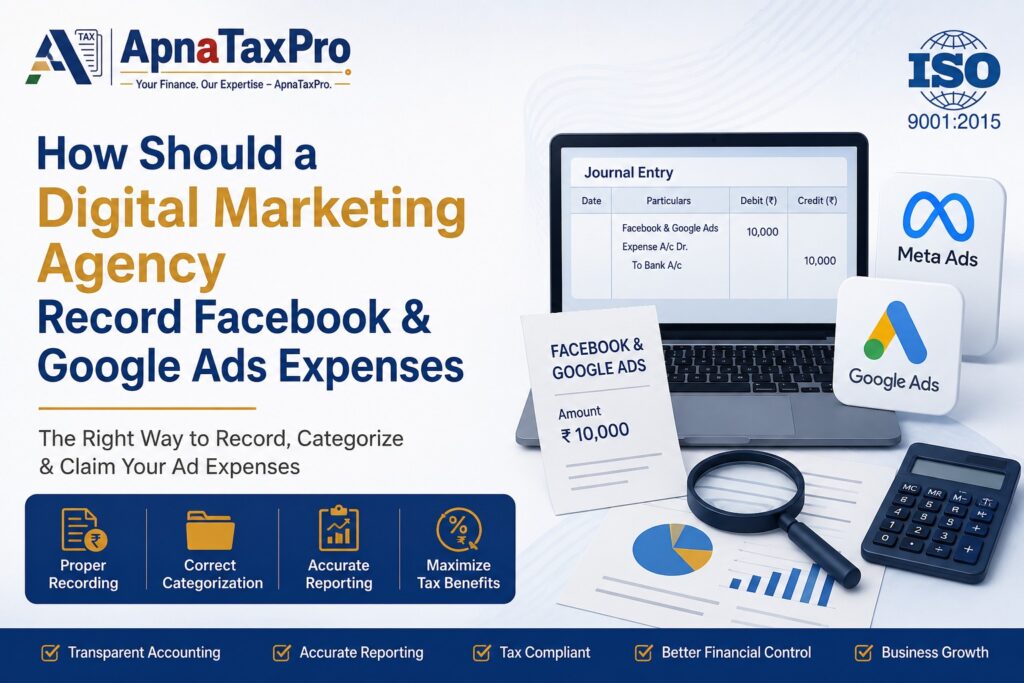
Digital marketing agencies spend a significant portion of their budget on online advertising platforms such as Facebook Ads, Instagram Ads, Google Ads, YouTube Ads, and other digital marketing channels.
While running campaigns is straightforward, many agency owners struggle with a common accounting question:
Should Facebook and Google Ads be recorded as an expense, a reimbursable client cost, or a pass-through transaction?
Incorrect accounting treatment can create issues in GST compliance, financial reporting, profitability analysis, and tax calculations.
Whether you operate a startup agency, a growing SME, or a large marketing firm, understanding the correct accounting treatment of advertising expenses is essential for maintaining proper account and records.
In this guide, we explain how digital marketing agencies should record Facebook and Google Ads expenses, the applicable GST implications, and best accounting practices.
Understanding the Nature of Advertising Expenses
Before passing accounting entries, agencies must determine who actually bears the advertising cost.
Generally, there are three common business scenarios:
Scenario 1: Agency Pays Ads for Its Own Marketing
If your agency runs Facebook or Google advertisements to promote its own services, the expense belongs to your business.
Examples:
- Lead generation campaigns
- Brand awareness campaigns
- Recruitment advertisements
- Website traffic campaigns
In this case, the amount is recorded as an advertising expense.
Scenario 2: Agency Pays Ads on Behalf of Client
Many digital marketing agencies pay Facebook or Google directly and later recover the amount from clients.
Here, the accounting treatment depends on the agreement structure.
Scenario 3: Client Pays Ads Directly
The client maintains their own ad account and pays Facebook or Google directly.
In this situation, the agency only invoices professional service fees.
No advertising expense is recorded in the agency books.
Accounting Entry for Agency’s Own Advertising Expenses
When Facebook or Google charges the agency’s bank account or credit card:
Journal Entry
| Particulars | Debit | Credit |
|---|---|---|
| Advertising Expense A/c | Dr | |
| Input GST (if eligible) | Dr | |
| Bank/Credit Card A/c | Cr |
Example
Suppose your agency spends ₹50,000 on Google Ads for promoting its services.
Entry:
- Advertising Expense A/c Dr ₹50,000
- Bank A/c Cr ₹50,000
This expense will appear in the Profit & Loss Account under marketing or advertising expenses.
Accounting Treatment When Agency Pays Ads for Clients
This is where many agencies make mistakes.
Method 1: Treat as Reimbursable Expense
If the agency merely pays on behalf of the client and recovers the exact amount:
Payment Entry
- Client Recoverable A/c Dr
- Bank/Credit Card A/c Cr
Recovery Entry
- Bank A/c Dr
- Client Recoverable A/c Cr
This prevents inflating revenue and expenses.
Method 2: Treat as Revenue and Expense
If the agency includes ad spend within its package pricing:
Example:
- Monthly package = ₹1,00,000
- Includes ad budget and management fees
Then:
Expense Entry
- Advertising Expense A/c Dr
- Bank A/c Cr
Sales Entry
- Client A/c Dr
- Professional Service Revenue A/c Cr
This method reflects the complete business activity.
GST Implications on Facebook and Google Ads
GST treatment depends on invoice structure and place of supply.
Key Points
- Facebook and Google generally issue invoices through their overseas entities.
- Reverse Charge Mechanism (RCM) may apply in certain cases.
- GST Registration details should be correctly updated in advertising accounts.
- Proper documentation is necessary to claim eligible tax benefits.
Businesses should regularly reconcile:
- Ad platform invoices
- Credit card statements
- Bank statements
- GST records
Failure to reconcile can create issues during GST audits.
A professional GST filling company can help maintain accurate compliance records.
Best Ledger Heads for Digital Marketing Agencies
The following ledger structure improves financial reporting:
| Ledger Name | Purpose |
| Advertising Expense | Agency marketing expenses |
| Facebook Ads Expense | Separate tracking |
| Google Ads Expense | Separate tracking |
| Client Recoverable Expense | Reimbursable ads |
| Marketing Revenue | Service income |
| Professional Fees | Consulting income |
| GST Input Credit | GST accounting |
Proper bookkeeping enables better campaign profitability analysis.
Why Proper Bookkeeping Matters
Many agencies focus on acquiring clients but neglect bookkeeping and accounting.
Poor accounting practices can lead to:
- Incorrect profit calculations
- GST mismatches
- Tax notices
- Cash flow problems
- Difficulty obtaining loans
- Poor financial decision-making
Strong bookkeeping helps agency owners understand:
Which clients are profitable?
Which campaigns generate the highest margins?
How much should be allocated toward growth?
What is the actual operating profit?
These insights are crucial for scaling a marketing agency.
Practical Example
Consider a digital marketing agency with:
- Google Ads Spend: ₹2,00,000
- Facebook Ads Spend: ₹1,50,000
- Management Fees: ₹75,000
If all ad costs are recovered from clients separately:
Revenue
₹75,000
Reimbursable Cost
₹3,50,000
If ad costs are included in package pricing:
Revenue
₹4,25,000
Advertising Expense
₹3,50,000
Gross Profit
₹75,000
The accounting treatment depends entirely on the contract structure.
Common Accounting Mistakes Agencies Should Avoid
1. Recording Client Ad Spend as Agency Expense
This can distort profitability.
2. Missing Platform Invoices
Always download monthly invoices from Facebook and Google.
3. Ignoring GST Compliance
Review GST implications regularly.
4. No Campaign-Wise Cost Tracking
Separate costs by client and campaign.
5. Poor Account and Records Maintenance
Maintain supporting documentation for every advertising transaction.
Financial Reporting Tips for Marketing Agencies
To improve financial reporting:
- Maintain separate client-wise ledgers.
- Track Facebook and Google expenses independently.
- Reconcile advertising invoices monthly.
- Use cloud-based accounting software.
- Review profitability every month.
- Maintain proper account and records.
- Conduct quarterly compliance reviews.
These practices support better business advisory and Virtual CFO Services.
Why Choose ApnaTaxPro?
Managing advertising expenses is only one part of running a successful agency. Businesses also require professional support for accounting, bookkeeping, GST compliance, taxation, payroll, and business registrations.
At APNATAXPRO we help startups, agencies, SMEs, MSMEs, freelancers, and service businesses maintain accurate financial records and business compliance.
Our services include:
- Accounting Services
- Bookkeeping Services
- Outsourced Accounting
- Online Accounting
- GST Registration
- GST Return Filing
- Income Tax Filing
- Professional Tax Compliance
- Payroll Services
- ROC Compliance
- Virtual CFO Services
- Financial Reporting
- Business Advisory
- Startup Registration
- Company Registration
- New Company Registration in Indore
- Gumasta Udyham Registration Assistance
- MSME Consulting
Businesses searching for Accounting Services in Indore, Bookkeeping Services in Indore, GST Consultant in Indore, Tax Consultant in Indore, Accountant Office Near Me, or support for Nearby SMEs Companies can benefit from professional financial management solutions.
Frequently Asked Questions (FAQs)
1. Are Facebook Ads considered a business expense?
Yes. If used for business promotion, Facebook Ads are generally treated as advertising or marketing expenses.
2. How should Google Ads be recorded in accounting?
Google Ads are usually recorded under Advertising Expense or Marketing Expense accounts.
3. Can agencies recover ad spend from clients?
Yes. Agencies may recover advertising costs separately or include them within service packages.
4. Is GST applicable on Facebook and Google Ads?
GST treatment depends on invoice structure, registration details, and applicable regulations.
5. Should Facebook and Google Ads have separate ledgers?
Yes. Separate ledgers improve reporting and campaign analysis.
6. Why is bookkeeping important for marketing agencies?
Bookkeeping helps track profitability, compliance, cash flow, and business performance.
7. Can Virtual CFO Services help digital marketing agencies?
Yes. Virtual CFO Services assist with budgeting, reporting, profitability analysis, and financial planning.
8. Should startups maintain separate advertising expense records?
Absolutely. Separate records improve transparency and decision-making.
Conclusion
Facebook and Google Ads are often among the largest expenses for digital marketing agencies. Recording them correctly is essential for accurate accounting, GST compliance, profitability analysis, and financial reporting.
Whether the advertising spend belongs to the agency or is incurred on behalf of a client, the accounting treatment should align with the underlying business arrangement. Proper bookkeeping, account and records management, and regular reconciliations can prevent compliance issues and provide valuable insights for growth.
Call to Action
Need help with accounting, bookkeeping, GST registration, financial reporting, or Virtual CFO Services for your digital marketing agency?
Contact APNATAXPRO today for professional Accounting Services in Indore, GST compliance support, business advisory, and complete financial management solutions designed for growing businesses.