
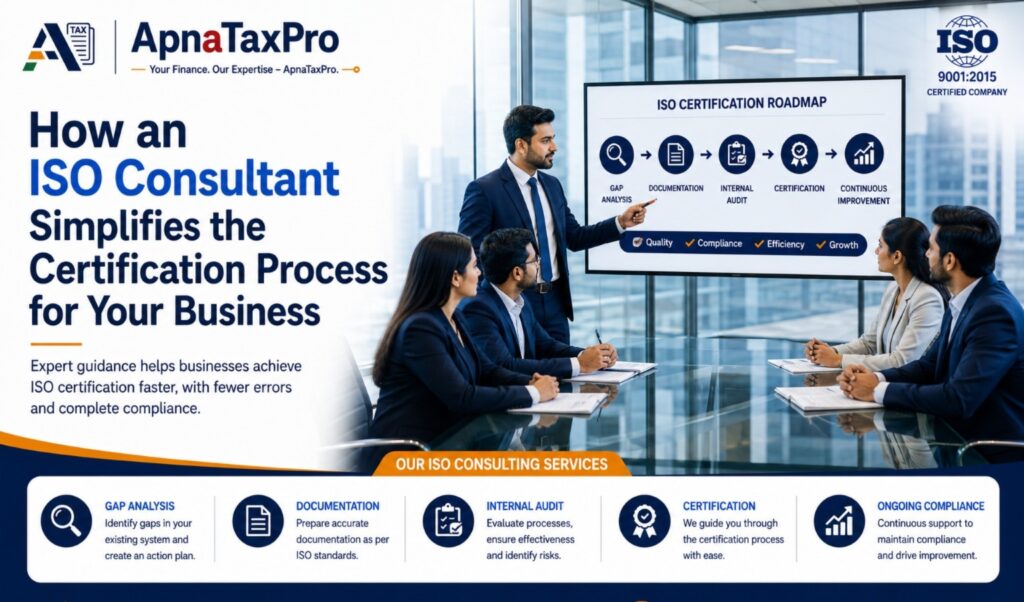
Imagine a business owner who has decided to obtain ISO certification after receiving repeated requests from customers and corporate buyers. The management understands that certification can improve credibility and create new business opportunities. However, once they begin researching the process, they discover multiple requirements, including documentation, process mapping, employee awareness, internal audits, corrective actions, and certification audits.
This situation is common for many startups, MSMEs, manufacturers, traders, and service providers across India. While ISO certification offers significant advantages, the process can appear complex without professional guidance.
An experienced ISO Consultant helps businesses understand the requirements, prepare proper documentation, implement standard operating procedures, conduct internal reviews, and coordinate with certification bodies. Instead of struggling with technical requirements, business owners can focus on running and growing their operations while experts handle the compliance process.
ISO certification also works best when supported by strong ACCOUNTING, BOOKKEEPING, organized ACCOUNT AND RECORDS, GST REGISTRATION, PROFESSIONAL TAX compliance, payroll management, and statutory documentation. Businesses searching online for an ACCOUNTANT OFFICE NEAR ME often require complete compliance support rather than a single service. A trusted advisory firm such as APNA TAX PRO can assist businesses by integrating financial compliance with ISO readiness, making the overall certification journey more structured and efficient.
Why ISO Certification Matters for Modern Businesses
Today’s customers, government organizations, corporate buyers, and international clients increasingly prefer businesses that follow standardized management systems.
ISO certification demonstrates that a company has established systematic processes for maintaining quality, consistency, compliance, and continual improvement.
Some of the major benefits include:
- Builds customer confidence
- Improves business credibility
- Enhances operational efficiency
- Reduces process errors
- Increases employee accountability
- Supports tender participation
- Creates export opportunities
- Strengthens brand reputation
- Encourages continual improvement
- Helps manage business risks effectively
Whether you operate a manufacturing unit, consultancy, software company, healthcare organization, educational institution, or service business, ISO certification signals professionalism and commitment to quality.
What Does an ISO Consultant Actually Do?
Many business owners believe that an ISO consultant only prepares documents. In reality, the consultant plays a much broader role throughout the certification process.
Understanding Your Business
The consultant begins by studying your business operations, organizational structure, products, services, customer requirements, and existing processes.
This assessment helps identify compliance gaps and determines what improvements are needed before certification.
Documentation Preparation
Documentation is one of the most important aspects of ISO certification.
An ISO consultant prepares or assists with:
- Quality Manual
- Standard Operating Procedures (SOPs)
- Process Flow Charts
- Risk Assessment Documents
- Quality Objectives
- Internal Policies
- Employee Responsibilities
- Record Maintenance Formats
- Audit Checklists
Proper documentation reduces confusion during certification audits and ensures consistency across departments.
Process Implementation
Documentation alone is not enough.
The consultant works with management and employees to implement practical systems that align with ISO requirements.
This includes:
- Employee training
- Process standardization
- Quality monitoring
- Record maintenance
- Corrective action procedures
- Performance measurement
When implementation is done correctly, businesses experience smoother operations even before receiving certification.
Common Challenges Businesses Face Without an ISO Consultant
Many organizations attempt certification independently but encounter avoidable challenges.
Some common issues include:
| Challenge | Business Impact | How an ISO Consultant Helps |
|---|---|---|
| Poor documentation | Audit observations | Creates complete ISO documentation |
| Lack of process clarity | Operational confusion | Standardizes business processes |
| Employee unawareness | Non-compliance | Conducts awareness sessions |
| Missing records | Audit delays | Develops proper record-keeping systems |
| Compliance gaps | Certification rejection | Identifies and closes compliance gaps |
| Unorganized ACCOUNT AND RECORDS | Difficulty proving compliance | Establishes structured documentation and record management |
| Incomplete GST REGISTRATION or PROFESSIONAL TAX compliance | Additional regulatory issues | Coordinates statutory compliance alongside ISO preparation |
| Lack of BOOKKEEPING discipline | Weak financial documentation | Encourages organized financial records to support management systems |
Businesses that maintain proper ACCOUNTING, BOOKKEEPING, tax compliance, and operational documentation generally find the ISO certification process much smoother than those with disorganized records.
How ISO Certification Supports Long-Term Business Growth
ISO certification is not just about obtaining a certificate—it is about creating a disciplined way of managing a business.
Organizations that adopt ISO standards often experience:
- Better customer retention
- Improved operational consistency
- Reduced business risks
- Stronger internal controls
- Better vendor management
- Improved financial planning
- Easier regulatory compliance
- Greater opportunities for business expansion
- Higher confidence among investors and financial institutions
For startups planning NEW COMPANY REGISTRATION IN INDORE, expanding into NEARBY SMES COMPANIES, or seeking partnerships with larger organizations, ISO certification can become an important competitive advantage.
Similarly, businesses that combine ISO implementation with reliable GST FILLING COMPANY services, GST REGISTRATION, GUMASTA UDHYAM registration, professional bookkeeping, and compliance management are often better prepared for sustainable growth.
Step-by-Step ISO Certification Process
Understanding the ISO certification journey helps businesses prepare effectively and avoid unnecessary delays. While specific requirements may vary depending on the ISO standard, the overall process is generally similar.
Step 1: Identify the Right ISO Standard
The first step is selecting the ISO standard that aligns with your business goals. Some commonly adopted standards include:
- ISO 9001 – Quality Management System
- ISO 14001 – Environmental Management System
- ISO 45001 – Occupational Health & Safety
- ISO 22000 – Food Safety Management
- ISO 27001 – Information Security Management
- ISO 13485 – Medical Devices Quality Management
Choosing the correct standard ensures your certification supports your business objectives and industry requirements.
Step 2: Business Assessment and Gap Analysis
An experienced ISO Consultant evaluates your existing systems, processes, documentation, and compliance status.
During this stage, the consultant identifies:
- Missing policies
- Documentation gaps
- Operational risks
- Process inconsistencies
- Compliance improvements
- Employee awareness requirements
This assessment becomes the roadmap for successful certification.
Step 3: Documentation Development
Documentation forms the backbone of every ISO Management System.
Typical documentation includes:
- Quality Manual
- Standard Operating Procedures (SOPs)
- Work Instructions
- Process Maps
- Risk Register
- Objectives and KPIs
- Corrective Action Procedures
- Internal Audit Formats
- Management Review Templates
- Record Maintenance Registers
Businesses with well-maintained ACCOUNT AND RECORDS, proper ACCOUNTING, and organized BOOKKEEPING generally complete this phase more efficiently.
Step 4: Process Implementation
Once documentation is ready, it must be implemented across departments.
Implementation may involve:
- Employee training
- Assigning responsibilities
- Daily record maintenance
- Process monitoring
- Quality checks
- Risk management
- Corrective actions
- Performance reviews
The goal is to ensure that documented procedures are consistently followed in day-to-day operations.
Step 5: Internal Audit
Before the certification audit, an internal audit is conducted to verify whether the management system is functioning effectively.
The internal audit helps identify:
- Documentation errors
- Process deviations
- Non-conformities
- Improvement opportunities
Corrective actions are implemented before proceeding to the external audit.
Step 6: Certification Audit
The certification body conducts an independent audit to evaluate your management system.
The audit generally includes:
- Review of documentation
- Employee interviews
- Process verification
- Record examination
- Site inspection
- Compliance verification
If the organization meets the required standard, the certification body issues the ISO Certificate.
Step 7: Continuous Improvement
ISO certification is not a one-time achievement.
Businesses should continue to:
- Monitor performance
- Conduct periodic internal audits
- Review business risks
- Update documentation
- Train employees
- Improve operational efficiency
Continual improvement is one of the core principles of ISO standards.
Different Types of Businesses That Benefit from ISO Certification
ISO certification is valuable for organizations of every size and industry.
Manufacturing Companies
Manufacturers use ISO certification to improve production quality, reduce defects, and strengthen customer confidence.
Service Providers
Consulting firms, digital agencies, educational institutions, healthcare providers, logistics companies, and IT businesses benefit from standardized service delivery.
Startups
Startups seeking funding, partnerships, or enterprise clients often find ISO certification enhances their professional image.
Businesses planning NEW COMPANY REGISTRATION IN INDORE can integrate ISO planning into their long-term growth strategy.
MSMEs and SMEs
Small businesses gain from:
- Better process control
- Reduced operational waste
- Improved customer satisfaction
- Higher competitiveness
- Stronger compliance management
Many NEARBY SMES COMPANIES adopt ISO certification to qualify for larger contracts and strengthen their market position.
Export-Oriented Businesses
Many international buyers prefer or require suppliers to maintain recognized ISO certifications.
Certification demonstrates commitment to internationally accepted management practices.
Practical Business Scenario
Consider a growing trading company that has experienced rapid business expansion over the past two years.
The company faces challenges such as:
- Inconsistent documentation
- Different working methods across departments
- Delayed customer responses
- Missing operational records
- Difficulty tracking quality issues
An ISO Consultant first performs a gap analysis, develops standardized operating procedures, trains employees, establishes documentation practices, and introduces periodic internal audits.
At the same time, the business strengthens its ACCOUNTING, BOOKKEEPING, ACCOUNT AND RECORDS, GST REGISTRATION, PROFESSIONAL TAX, and statutory compliance processes. This integrated approach not only prepares the company for ISO certification but also improves operational efficiency and management visibility.
The result is a business that is better organized, more compliant, and well-positioned for sustainable growth.
Common Mistakes Businesses Should Avoid
Many organizations delay certification because of avoidable mistakes.
1. Treating ISO as Only a Certificate
ISO should be viewed as a management improvement system rather than just a document for marketing purposes.
2. Ignoring Employee Training
Employees must understand the documented procedures.
Without proper awareness, implementation becomes ineffective.
3. Poor Documentation
Incomplete or outdated documentation often results in audit observations.
4. Weak Record Maintenance
Maintaining accurate records is essential.
Organized ACCOUNT AND RECORDS support both operational efficiency and audit readiness.
5. Delaying Corrective Actions
Identified issues should be resolved promptly.
Ignoring non-conformities can delay certification.
6. Choosing Consultants Only on Price
Selecting the lowest-cost consultant without evaluating experience may lead to poor documentation, implementation gaps, and additional costs later.
Businesses should prioritize expertise, practical guidance, and industry understanding.
Practical Tips for a Smooth ISO Certification Journey
To make certification more efficient, consider these best practices:
- Define clear business objectives before starting.
- Select the appropriate ISO standard for your industry.
- Maintain accurate business records from day one.
- Keep ACCOUNTING and BOOKKEEPING updated regularly.
- Ensure timely GST REGISTRATION and statutory compliance.
- Complete PROFESSIONAL TAX registrations where applicable.
- Conduct periodic internal reviews.
- Involve employees throughout implementation.
- Review documentation regularly.
- Work with an experienced ISO Consultant who understands your business operations.
Why Choose ApnaTaxPro for Business Compliance and ISO Support?
Obtaining ISO certification becomes easier when your business already follows strong financial and statutory compliance practices.
At APNA TAX PRO (APNATAXPRO), we help businesses build a solid compliance foundation that supports long-term growth and operational excellence.
Our professional services include:
- Accounting Services for accurate financial management
- Bookkeeping Services to maintain organized financial records
- Professional Tax registration and compliance support
- GST Registration and GST Return Filing
- Income Tax Filing
- TDS Compliance
- Payroll Services
- Business Registration
- Company Registration
- New Company Registration in Indore
- Gumasta Udyam Registration
- ROC Compliance
- Virtual CFO Services
- Financial Reporting
- Business Advisory
- Compliance Management
- Support in maintaining proper ACCOUNT AND RECORDS
For businesses searching online for an ACCOUNTANT OFFICE NEAR ME, GST FILLING COMPANY, Accounting Services in Indore, Bookkeeping Services in Indore, GST Consultant in Indore, or Tax Consultant in Indore, choosing a partner that understands both financial compliance and business processes can simplify your growth journey.
Our objective is not only to help businesses meet regulatory requirements but also to establish systems that improve efficiency, transparency, and long-term sustainability.
Conclusion
ISO certification is much more than a formal requirement—it is a structured approach to building a stronger, more efficient, and customer-focused business.
With the guidance of an experienced ISO Consultant, businesses can simplify documentation, improve internal processes, prepare confidently for audits, and establish a culture of continual improvement. When ISO implementation is supported by organized ACCOUNTING, BOOKKEEPING, ACCOUNT AND RECORDS, GST REGISTRATION, PROFESSIONAL TAX, and statutory compliance, organizations are better equipped to scale, attract new clients, and strengthen their reputation in competitive markets.
Whether you are a startup, MSME, manufacturer, trader, or service provider, investing in professional compliance and process management today can create long-term business value.
Call to Action
Planning to obtain ISO certification or strengthen your business compliance systems?
ApnaTaxPro helps startups, MSMEs, traders, manufacturers, and service providers build a strong compliance framework through professional Accounting, Bookkeeping, GST Registration, Professional Tax, Company Registration, ROC Compliance, Virtual CFO Services, Financial Reporting, and Business Advisory solutions.
Contact ApnaTaxPro today to discuss your business requirements and take the next step toward organized compliance, operational excellence, and sustainable business growth.
Frequently Asked Questions (FAQs)
1. What does an ISO Consultant do?
An ISO Consultant helps businesses understand ISO requirements, prepare documentation, implement management systems, conduct internal audits, and coordinate with certification bodies. Their guidance simplifies the certification process and reduces compliance risks.
2. Why should a business hire an ISO Consultant?
Hiring an ISO Consultant saves time, minimizes documentation errors, improves implementation, and increases the likelihood of successfully achieving ISO certification on the first attempt.
3. How long does the ISO certification process take?
The timeline depends on the organization’s size, the chosen ISO standard, and its readiness. Small businesses with organized documentation may complete the process in a few months, while larger organizations may require additional time for implementation and audits.
4. Is ISO certification mandatory in India?
ISO certification is generally voluntary. However, many government tenders, corporate buyers, exporters, and multinational companies prefer or require suppliers to have relevant ISO certifications.
5. Can startups and MSMEs obtain ISO certification?
Yes. Startups, MSMEs, traders, manufacturers, and service providers can all benefit from ISO certification. It helps improve operational efficiency, customer trust, and business credibility.
6. How do Accounting and Bookkeeping support ISO certification?
Well-maintained ACCOUNTING, BOOKKEEPING, and ACCOUNT AND RECORDS make it easier to demonstrate compliance, maintain accurate documentation, and support internal audits.
7. Can ApnaTaxPro help with business compliance before ISO certification?
Yes. ApnaTaxPro assists businesses with Accounting Services, Bookkeeping, GST Registration, Professional Tax, Income Tax, Payroll, Business Registration, ROC Compliance, Virtual CFO Services, and financial reporting, creating a strong compliance foundation for ISO readiness.
8. Which businesses benefit the most from ISO certification?
Manufacturers, exporters, startups, MSMEs, healthcare organizations, educational institutions, IT companies, logistics firms, traders, and service providers can all benefit from implementing ISO management systems.