
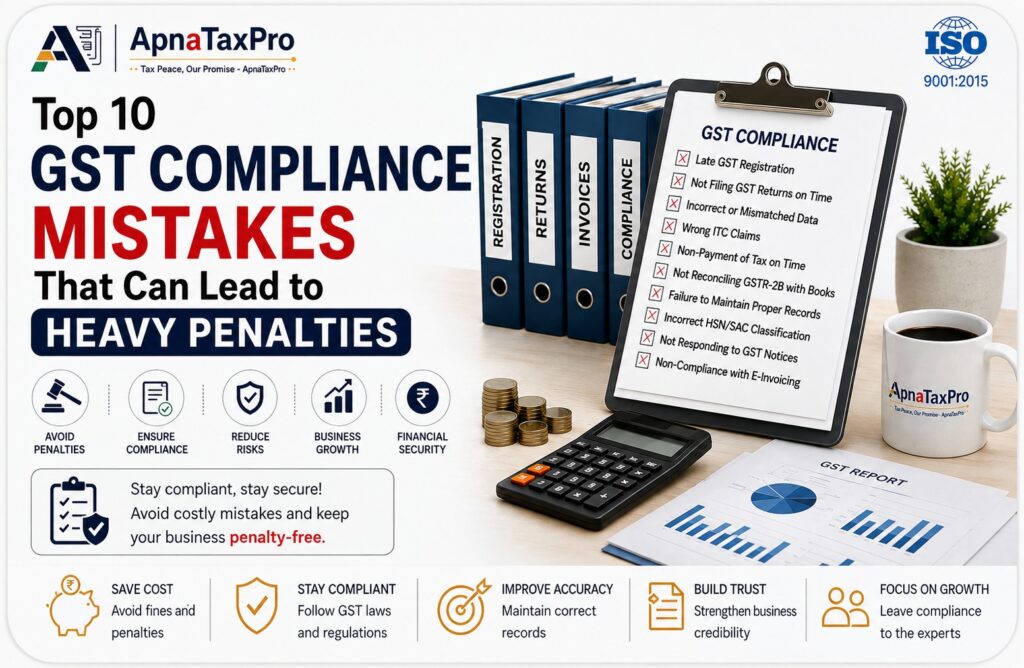
Imagine a business owner who is focused on sales, customer service, and daily operations. GST compliance often becomes a task that gets postponed until the last moment. A delayed return, a missed reconciliation, or an incorrect tax payment may appear minor initially, but these mistakes can result in notices, interest, penalties, blocked Input Tax Credit (ITC), and unnecessary stress.
Many startups, traders, manufacturers, service providers, freelancers, and SMEs face GST-related challenges because they do not maintain proper account and records or fail to monitor compliance regularly.
Understanding common GST mistakes is the first step toward avoiding financial losses. In this guide, we discuss the top 10 GST compliance mistakes that can lead to heavy penalties and explain how businesses can stay compliant.
Why GST Compliance Matters
GST compliance is not limited to filing returns. It includes maintaining proper accounting records, timely tax payment, invoice management, reconciliation, GST registration requirements, and regular monitoring of tax liabilities.
Strong accounting and bookkeeping practices help businesses avoid unnecessary notices and penalties while improving financial reporting and decision-making.
1. Delayed GST Return Filing
One of the most common GST compliance mistakes is filing returns after the due date.
Consequences
- Late fees
- Interest on tax liability
- GST notices
- Compliance rating issues
Practical Example
A business delays filing GSTR-3B for several months. Even if tax is eventually paid, interest and late fees continue to accumulate.
Solution
- Maintain a GST compliance calendar.
- Use professional accounting services.
- Work with a GST filing company for timely submissions.
2. Incorrect Claim of Input Tax Credit (ITC)
Many businesses claim ITC without proper verification of supplier invoices.
Common Errors
- Claiming ITC on ineligible expenses
- Missing supplier reconciliation
- Claiming duplicate credits
Consequences
- Reversal of ITC
- Interest and penalties
- GST scrutiny
Solution
Regularly reconcile purchase records with GST returns and maintain proper bookkeeping records.
3. Failure to Reconcile GST Returns
Businesses often fail to reconcile:
- Sales records
- Purchase records
- GSTR-1
- GSTR-3B
- Books of accounts
Differences between returns and accounting records can trigger notices from tax authorities.
Best Practice
Monthly reconciliation should be a mandatory compliance activity for every business.
4. Not Maintaining Proper Account and Records
The GST law requires businesses to maintain proper books of accounts and supporting documents.
Records to Maintain
- Sales invoices
- Purchase invoices
- Expense records
- Bank statements
- Inventory records
- Tax payment records
Businesses with weak account and records management often struggle during audits and assessments.
Solution
Use professional accounting and bookkeeping services to maintain organized financial records.
5. Delayed GST Registration
Many businesses cross the registration threshold but continue operations without obtaining GST registration.
Risks
- Penalty for non-registration
- Tax liability from the effective date
- Business compliance issues
Startups and growing businesses should regularly monitor turnover and registration requirements.
6. Incorrect GST Classification
Using the wrong HSN code or GST rate can create significant compliance problems.
Common Issues
- Underpayment of GST
- Excess tax collection
- Incorrect invoicing
Solution
Seek guidance from a GST consultant before finalizing tax classifications.
7. Ignoring GST Notices
Many business owners delay responding to GST notices because they assume the matter is not urgent.
Consequences
- Higher penalties
- Cancellation of GST registration
- Litigation costs
Best Practice
Review every GST communication immediately and respond within the prescribed timeline.
8. Non-Payment or Short Payment of GST
Some businesses file returns but fail to pay the correct GST liability.
Reasons
- Cash flow issues
- Incorrect calculations
- Poor financial reporting
Consequences
| Issue | Impact |
|---|---|
| Short Payment | Interest Liability |
| Non-Payment | GST Notice |
| Continued Default | Penalties and Recovery Action |
Solution
Regular accounting and financial reporting help identify tax liabilities before due dates.
9. Errors in GST Invoices
GST invoices must contain mandatory information.
Common Invoice Mistakes
- Wrong GSTIN
- Incorrect tax calculation
- Missing HSN code
- Incorrect place of supply
Invoice errors may impact ITC claims and trigger compliance issues.
Solution
Implement standardized invoicing procedures and periodic reviews.
10. Lack of Professional Compliance Support
Many SMEs attempt to manage GST internally without adequate expertise.
While this may work initially, growing businesses often face challenges related to:
- GST Return Filing
- Professional Tax compliance
- Payroll compliance
- TDS compliance
- Financial reporting
- ROC compliance
Professional support helps reduce compliance risks and improve operational efficiency.
GST Compliance Checklist for Businesses
Use this quick checklist:
File GST returns on time
Reconcile GST returns monthly
Maintain proper account and records
Verify ITC eligibility
Monitor GST registration requirements
Review invoices regularly
Respond promptly to GST notices
Maintain accurate accounting records
Conduct periodic compliance reviews
Seek professional guidance when needed
How GST Compliance Supports Business Growth
Many business owners view GST as a regulatory burden. However, effective compliance provides several benefits:
- Better financial reporting
- Improved cash flow visibility
- Easier loan approvals
- Stronger business credibility
- Reduced legal risks
- Better management decisions
Businesses with organized accounting and bookkeeping systems are generally more prepared for growth opportunities.
Why Choose ApnaTaxPro
ApnaTaxPro helps startups, SMEs, MSMEs, traders, manufacturers, freelancers, and service providers manage business compliance efficiently.
Our services include:
- Accounting Services
- Bookkeeping Services
- GST Compliance
- GST Registration
- GST Return Filing
- Income Tax Filing
- Professional Tax Compliance
- Payroll Services
- TDS Compliance
- Business Registration
- Company Registration
- New Company Registration in Indore
- ROC Compliance
- Virtual CFO Services
- Financial Reporting
- Business Advisory
- Gumasta Udyam Registration Support
Whether you are searching for an accountant office near me, accounting services in Indore, bookkeeping services in Indore, a GST consultant in Indore, or support for nearby SMEs companies, APNA TAX PRO provides practical compliance and financial management solutions.
Businesses benefit from structured accounting and business compliance processes that help reduce risks and improve operational efficiency.
Frequently Asked Questions (FAQs)
1. What is the penalty for late GST return filing?
Late filing can attract late fees and interest on outstanding tax liability.
2. Can GST registration be cancelled for non-compliance?
Yes. Continuous non-filing of returns may result in cancellation of GST registration.
3. Why is GST reconciliation important?
It helps identify mismatches between books of accounts and GST returns, reducing compliance risks.
4. How often should GST records be reviewed?
Businesses should review GST records monthly.
5. What documents should be maintained under GST?
Invoices, purchase records, sales records, bank statements, inventory records, and tax payment documents.
6. How can bookkeeping help GST compliance?
Proper bookkeeping improves accuracy in tax calculations, reconciliations, and reporting.
7. Should startups hire GST professionals?
Yes. Professional guidance reduces compliance errors and helps businesses focus on growth.
8. Can accounting services help avoid GST penalties?
Yes. Accurate accounting and financial reporting significantly reduce compliance risks.
Conclusion
GST compliance is not just about filing returns. It involves maintaining proper records, monitoring tax liabilities, reconciling data, and following regulatory requirements consistently.
The most common GST compliance mistakes—including delayed filing, incorrect ITC claims, poor record maintenance, invoice errors, and ignoring notices—can result in significant penalties and business disruptions.
Businesses that invest in proper accounting, bookkeeping, financial reporting, and compliance management are better positioned to avoid penalties and achieve sustainable growth.
Call to Action
Need expert help with GST compliance, accounting, bookkeeping, professional tax, GST registration, company registration, payroll, or business advisory services?
Contact APNATAXPRO today for reliable Accounting Services in Indore, Bookkeeping Services in Indore, GST Return Filing, Business Compliance, and Virtual CFO Services tailored to your business needs.