
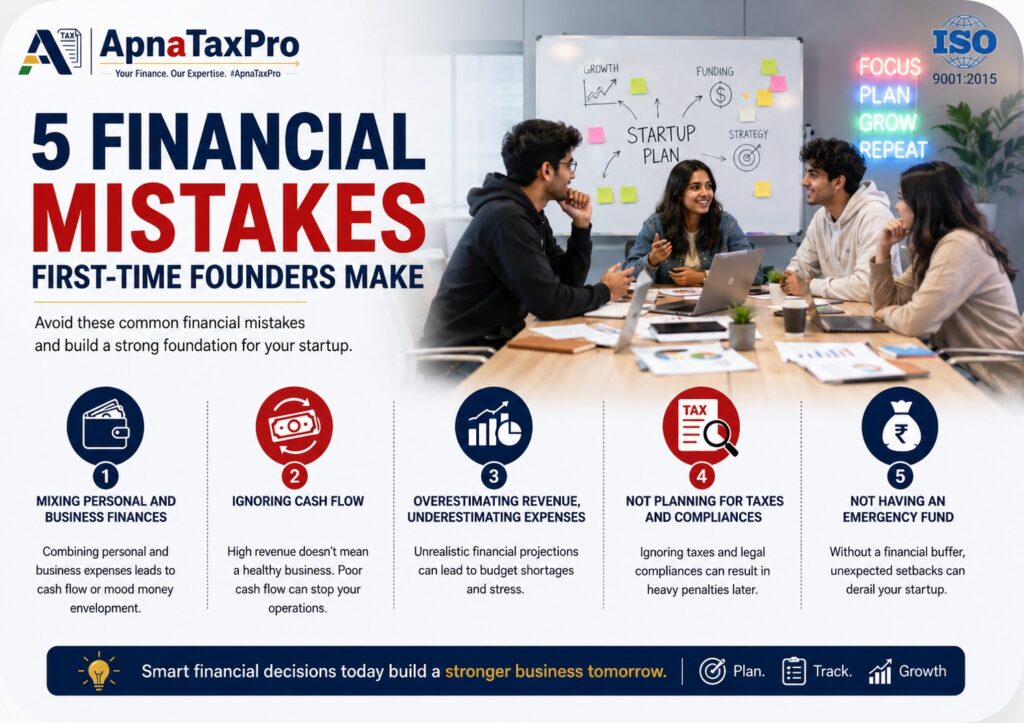
Starting a business is exciting. Founders focus on developing products, finding customers, hiring employees, and growing revenue. However, one critical area often gets ignored during the early stages—financial management.
Many startups fail not because they lack a good product or market opportunity, but because they make avoidable financial mistakes. Poor accounting, inadequate bookkeeping, missing compliance deadlines, and lack of financial planning can create serious problems even for businesses with strong growth potential.
Whether you are launching a startup, running an MSME, or planning a new company registration in Indore, understanding these financial mistakes can help you build a stronger and more sustainable business.
Why Financial Discipline Matters for Startups
Every founder wants growth. But growth without financial control can quickly become dangerous.
Proper ACCOUNTING, BOOKKEEPING, account and records management, tax planning, and compliance help founders:
- Monitor cash flow
- Control business expenses
- Make informed decisions
- Avoid tax penalties
- Attract investors
- Improve profitability
Let’s explore the five most common financial mistakes made by first-time founders.
1. Ignoring Proper Accounting and Bookkeeping
One of the biggest mistakes founders make is treating accounting as a year-end activity.
Many businesses start by tracking income and expenses in spreadsheets or personal notebooks. While this may work initially, it becomes difficult to manage as transactions increase.
Problems Caused by Poor Accounting
- Missing business expenses
- Incorrect profit calculations
- GST filing errors
- Cash flow confusion
- Difficulty obtaining loans or investments
Example
A startup may appear profitable based on bank balance alone. However, once unpaid vendor bills and tax liabilities are considered, the actual financial position may be completely different.
Professional ACCOUNTING and BOOKKEEPING help maintain accurate account and records from day one.
Best Practice
- Use accounting software
- Separate business and personal expenses
- Maintain monthly financial reports
- Review financial statements regularly
2. Not Monitoring Cash Flow
Revenue and cash flow are not the same thing.
Many founders celebrate sales growth while ignoring cash collection cycles.
Common Cash Flow Problems
- Customers paying late
- High operating expenses
- Excess inventory purchases
- Unplanned business spending
A company may generate ₹20 lakh in annual revenue but still struggle to pay salaries if customer payments are delayed.
Cash Flow Management Tips
- Track receivables weekly
- Maintain emergency reserves
- Forecast monthly cash flow
- Control unnecessary expenses
- Negotiate better payment terms with vendors
Successful founders focus on cash flow just as much as revenue growth.
3. Delaying GST Registration and Compliance
Many new entrepreneurs underestimate the importance of GST compliance.
Some founders delay GST REGISTRATION because they believe compliance can wait until business grows. Unfortunately, delayed registration and filing often result in penalties and operational issues.
Risks of Ignoring GST
- Late fees and penalties
- Input Tax Credit loss
- Vendor compliance issues
- Business credibility concerns
Whether you operate as a trader, manufacturer, freelancer, or service provider, timely GST REGISTRATION is essential.
A professional GST FILLING COMPANY can help ensure:
- GST Registration
- GST Return Filing
- Compliance monitoring
- Notice management
- Tax reconciliation
Compliance Checklist
| Activity | Recommended Frequency |
|---|---|
| GST Return Filing | Monthly/Quarterly |
| Tax Review | Monthly |
| Account Reconciliation | Monthly |
| Compliance Audit | Quarterly |
4. Mixing Personal and Business Finances
Many first-time founders use personal bank accounts for business transactions.
While this may seem convenient, it creates major accounting and taxation issues.
Problems Created
- Inaccurate financial reports
- Tax complications
- Difficult audits
- Poor investor confidence
When business and personal expenses are mixed, understanding the true financial health of the company becomes difficult.
Recommended Approach
- Open a dedicated business bank account
- Maintain separate accounting records
- Track founder withdrawals properly
- Use accounting software for transparency
Investors and lenders prefer businesses with professionally maintained financial systems.
5. Operating Without Financial Planning
Many startups focus entirely on sales and ignore financial forecasting.
Without a financial plan, founders often struggle to answer critical questions:
- How much capital is required?
- When will the business become profitable?
- What expenses are increasing?
- How much tax liability will arise?
What Financial Planning Should Include
Revenue Forecasting
Estimate realistic sales targets based on market conditions.
Expense Planning
Track operational costs, payroll, marketing, and compliance expenses.
Tax Planning
Understand GST, PROFESSINAL TAX, TDS, and Income Tax obligations.
Growth Planning
Prepare funding and expansion strategies.
Role of Virtual CFO Services
Many startups cannot afford a full-time CFO. Virtual CFO Services provide:
- Financial reporting
- Budget planning
- Cash flow management
- Strategic financial guidance
- Investor-ready reports
This allows founders to make informed decisions without significant overhead costs.
Additional Financial Areas Founders Often Overlook
Business Registration and Compliance
New founders often delay essential registrations such as:
- GST Registration
- Udyam Registration
- Gumasta Udyam Registration
- Startup Registration
- Company Registration
Timely registrations help businesses operate legally and access government benefits.
Record Keeping
Maintaining account and records is essential for:
- Tax compliance
- Audits
- Loan applications
- Investor due diligence
Building Financial Systems Early
The earlier a founder implements financial processes, the easier it becomes to scale operations.
How to Avoid These Financial Mistakes
Financial Foundation Checklist
Maintain proper ACCOUNTING
Invest in professional BOOKKEEPING
Complete GST REGISTRATION on time
Track account and records regularly
Monitor cash flow
Separate business and personal finances
Create financial forecasts
Review compliance requirements
Use Virtual CFO Services when needed
Seek expert business advisory support
Why Choose ApnaTaxPro
At APNATAXPRO we understand the financial challenges faced by startups, MSMEs, freelancers, and growing businesses.
Our team supports businesses through:
- Accounting Services
- Bookkeeping Services
- GST Registration
- GST Return Filing
- Income Tax Filing
- Professional Tax Compliance
- Payroll Services
- Business Registration
- ROC Compliance
- Financial Reporting
- Virtual CFO Services
- Business Advisory Services
Whether you are searching for an accountant office near me, looking for accounting services in Indore, planning new company registration in Indore, or exploring growth opportunities among nearby SMEs companies, our team helps businesses establish strong financial foundations.
Our objective is simple: help founders stay compliant, improve profitability, and make better financial decisions.
Frequently Asked Questions
1. Why do startups fail financially?
Most startups face challenges due to poor cash flow management, inadequate accounting, lack of planning, and compliance issues.
2. When should a startup hire an accountant?
Founders should establish accounting systems from the beginning of business operations.
3. Is bookkeeping necessary for small businesses?
Yes. Bookkeeping helps track income, expenses, profitability, and tax liabilities accurately.
4. What are the benefits of GST registration?
GST registration improves compliance, enables Input Tax Credit benefits, and enhances business credibility.
5. What is the difference between accounting and bookkeeping?
Bookkeeping records transactions, while accounting analyzes and interprets financial data.
6. What are Virtual CFO Services?
Virtual CFO Services provide strategic financial guidance without hiring a full-time CFO.
7. Why should founders maintain separate business accounts?
Separate accounts improve transparency, compliance, and financial reporting accuracy.
8. How can ApnaTaxPro help startups?
ApnaTaxPro offers accounting, bookkeeping, GST compliance, tax filing, payroll, business registration, and advisory services tailored for startups and MSMEs.
Conclusion
Financial mistakes made during the early stages of a business can create long-term challenges. First-time founders who invest in proper accounting, bookkeeping, compliance, cash flow management, and financial planning position themselves for sustainable growth.
Strong financial systems are not just about compliance—they provide the insights needed to make smarter business decisions and build a profitable company.
Call to Action
Starting a new business or struggling to manage your finances?
Contact ApnaTaxPro today for expert Accounting Services, Bookkeeping Services, GST Registration, Tax Compliance, Virtual CFO Services, Financial Reporting, and Business Advisory support. Let our team help you build a financially strong and compliant business from day one.