
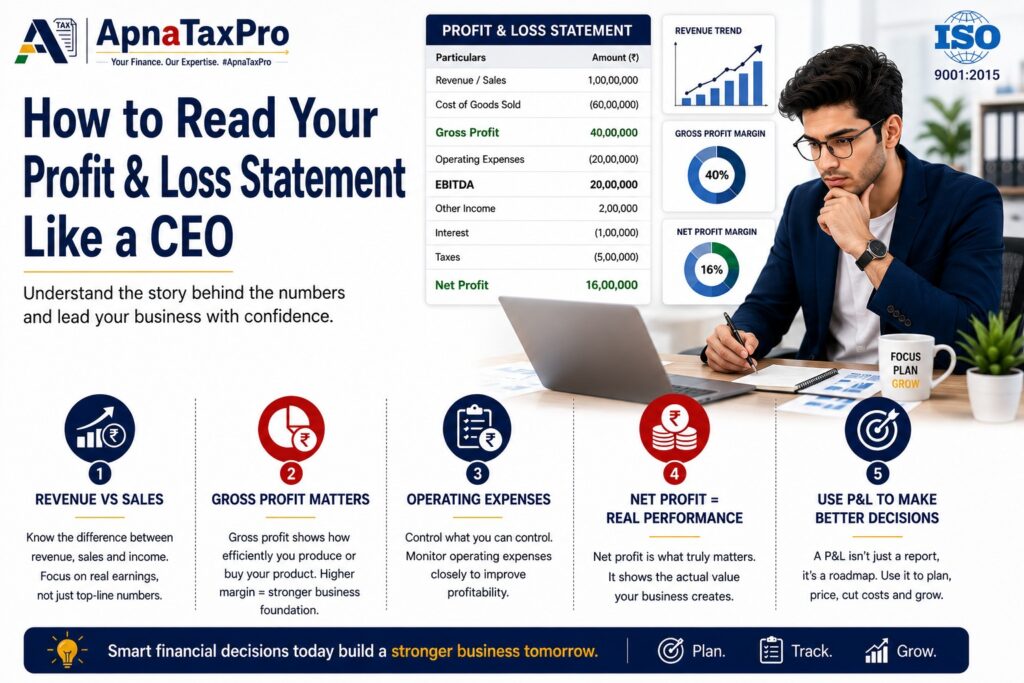
Many business owners work hard every day to increase sales, manage employees, serve customers, and grow their companies. Yet, when asked a simple question—”How much profit did your business actually make last month?”—they often struggle to answer confidently.
This happens because many entrepreneurs focus on revenue while ignoring their Profit & Loss (P&L) Statement.
A business may generate ₹10 lakh in sales every month, but if expenses are uncontrolled, the actual profit could be very small. On the other hand, a company with lower sales but better financial management may earn significantly higher profits.
Successful CEOs do not look only at sales figures. They regularly review their Profit & Loss Statement to understand where money comes from, where it goes, and how to improve profitability.
In this guide, we’ll explain how to read your Profit & Loss Statement like a CEO and use it to make smarter business decisions.
What Is a Profit & Loss Statement?
A Profit & Loss Statement, also known as an Income Statement, is a financial report that summarizes:
- Revenue earned
- Cost of goods sold
- Operating expenses
- Taxes
- Net profit or loss
It shows whether your business is making money or losing money during a specific period.
Your P&L statement is one of the most important financial reporting tools used by business owners, investors, banks, and management teams.
Why CEOs Pay Attention to P&L Statements
CEOs understand that revenue alone does not determine success.
A good P&L statement helps answer questions such as:
- Is the business profitable?
- Are expenses increasing?
- Which products generate the highest margins?
- Are employee costs under control?
- Is the company financially healthy?
Without proper ACCOUNTING and BOOKKEEPING, business owners often make decisions based on assumptions instead of facts.
Key Sections of a Profit & Loss Statement
1. Revenue (Sales)
Revenue represents the total income generated from selling products or services.
Example:
| Particulars | Amount |
|---|---|
| Product Sales | ₹8,00,000 |
| Service Income | ₹2,00,000 |
| Total Revenue | ₹10,00,000 |
Many business owners focus only on revenue.
However, CEOs know that revenue is just the starting point.
2. Cost of Goods Sold (COGS)
COGS includes direct costs related to delivering products or services.
Examples:
- Raw materials
- Manufacturing costs
- Direct labor
- Packaging expenses
Example:
| Particulars | Amount |
|---|---|
| Revenue | ₹10,00,000 |
| COGS | ₹6,00,000 |
| Gross Profit | ₹4,00,000 |
3. Gross Profit
Gross Profit indicates how efficiently your core business operates.
Formula:
Gross Profit = Revenue – Cost of Goods Sold
A declining gross profit margin may indicate:
- Rising material costs
- Pricing issues
- Operational inefficiencies
CEOs closely monitor gross margins because they directly impact profitability.
4. Operating Expenses
These are expenses required to run the business.
Examples include:
- Office rent
- Employee salaries
- Professional Tax
- Utilities
- Marketing costs
- Software subscriptions
- Accounting and bookkeeping expenses
Common operating expenses include maintaining ACCOUNT AND RECORDS, compliance costs, payroll processing, and administrative expenses.
5. EBITDA
EBITDA stands for:
Earnings Before Interest, Taxes, Depreciation, and Amortization
It measures the operational profitability of the business.
Many investors and lenders use EBITDA to evaluate business performance.
6. Net Profit
Net Profit is the final amount remaining after deducting all expenses.
Formula:
Net Profit = Revenue – All Expenses
Example:
| Particulars | Amount |
|---|---|
| Revenue | ₹10,00,000 |
| Total Expenses | ₹8,50,000 |
| Net Profit | ₹1,50,000 |
This is the figure CEOs focus on most.
How CEOs Analyze a P&L Statement
Look Beyond Revenue
Many business owners celebrate higher sales.
CEOs ask:
- Did profits increase?
- Did margins improve?
- Did costs rise faster than revenue?
Higher sales without profitability can be dangerous.
Monitor Expense Ratios
Compare each expense category against revenue.
Example:
| Expense Type | Percentage of Revenue |
|---|---|
| Salary Cost | 20% |
| Marketing | 8% |
| Rent | 5% |
| Administration | 3% |
This helps identify overspending.
Track Trends Monthly
Review your P&L every month.
Ask:
- Is profit increasing?
- Are costs growing?
- Is revenue seasonal?
Monthly tracking helps avoid surprises.
Compare Actual vs Budget
CEOs compare actual performance with planned budgets.
Example:
| Particulars | Budget | Actual |
|---|---|---|
| Revenue | ₹10,00,000 | ₹9,20,000 |
| Expenses | ₹7,00,000 | ₹7,80,000 |
This analysis helps identify areas needing attention.
Common Mistakes Business Owners Make
Ignoring Financial Reports
Many MSMEs review financial reports only during tax season.
This limits visibility into business performance.
Mixing Personal and Business Expenses
Personal expenses should never be recorded as business expenses.
Proper ACCOUNTING AND financial discipline are essential.
Poor Bookkeeping
Without accurate BOOKKEEPING, your P&L statement becomes unreliable.
Incomplete records often lead to poor decisions.Focusing Only on GST Compliance
Many businesses engage a GST FILLING COMPANY only for GST Return Filing and GST REGISTRATION.
However, financial reporting and profitability analysis are equally important.
Business Scenario: Understanding Profitability
Consider two businesses.
| Particulars | Company A | Company B |
|---|---|---|
| Revenue | ₹20 Lakh | ₹15 Lakh |
| Net Profit | ₹1 Lakh | ₹3 Lakh |
Many people assume Company A is performing better.
A CEO knows Company B is healthier because it generates more profit despite lower sales.
This demonstrates why profitability matters more than revenue alone.
How Proper Accounting Improves Profitability
Professional ACCOUNTING helps businesses:
- Control expenses
- Improve cash flow
- Maintain accurate account and records
- Track profitability
- Prepare financial reports
- Meet compliance requirements
Whether you operate a startup, manufacturing unit, trading company, or service business, reliable accounting systems are essential.
Why SMEs Need Professional Financial Reporting
Many nearby SMEs companies struggle because they lack timely financial information.
Professional financial reporting helps:
- Make better decisions
- Improve budgeting
- Secure business loans
- Attract investors
- Reduce compliance risks
For growing businesses, outsourced accounting and Virtual CFO Services can provide expert financial insights without hiring a full-time finance team.
Why Choose ApnaTaxPro
At APNATAXPRO, we help businesses transform financial data into actionable business intelligence.
Our services include:
- Accounting Services
- BOOKKEEPING Services
- GST Registration
- GST Return Filing
- Income Tax Filing
- TDS Compliance
- Payroll Services
- Professional Tax Compliance
- ROC Compliance
- Virtual CFO Services
- Financial Reporting
- Business Advisory
- Startup Registration
- New Company Registration in Indore
- Gumasta Udyham Assistance
- MSME Registration
Businesses searching for an accountant office near me often need more than compliance support. They need reliable financial insights that help them grow.
APNATAXPRO supports startups, SMEs, traders, manufacturers, freelancers, and service providers with practical accounting and business advisory solutions.
For businesses looking for Accounting Services in Indore, Bookkeeping Services in Indore, GST Consultant in Indore, and Tax Consultant in Indore, our focus remains on accuracy, compliance, and business growth.
Frequently Asked Questions (FAQs)
1. What is a Profit & Loss Statement?
A Profit & Loss Statement shows a business’s revenue, expenses, and net profit over a specific period.
2. How often should I review my P&L Statement?
Business owners should review it monthly for better financial control.
3. Why is net profit more important than revenue?
Revenue shows sales, while net profit shows actual earnings after expenses.
4. Can bookkeeping affect profitability?
Yes. Accurate bookkeeping helps identify unnecessary expenses and improve decision-making.
5. Do startups need financial reporting?
Absolutely. Financial reporting helps startups manage growth, budgets, and investor expectations.
6. What is the difference between gross profit and net profit?
Gross profit excludes direct costs, while net profit includes all business expenses.
7. How can Virtual CFO Services help?
Virtual CFO Services provide strategic financial planning, reporting, forecasting, and profitability analysis.
8. Can ApnaTaxPro help with accounting and compliance?
Yes. ApnaTaxPro provides accounting, taxation, GST, payroll, registration, and advisory services for businesses.
Conclusion
A Profit & Loss Statement is more than a compliance document. It is a decision-making tool that reveals the true financial health of your business.
CEOs use P&L statements to understand profitability, control expenses, improve margins, and make strategic decisions. By reviewing financial reports regularly, business owners can identify opportunities, solve problems early, and build sustainable growth.
If you want to grow your business confidently, start reading your Profit & Loss Statement like a CEO.
Call to Action
Need help understanding your financial reports, improving profitability, or managing business compliance?
Contact ApnaTaxPro today for expert Accounting Services, Bookkeeping Services, GST Compliance, Income Tax Filing, Virtual CFO Services, Financial Reporting, and Business Advisory solutions tailored to your business growth.