
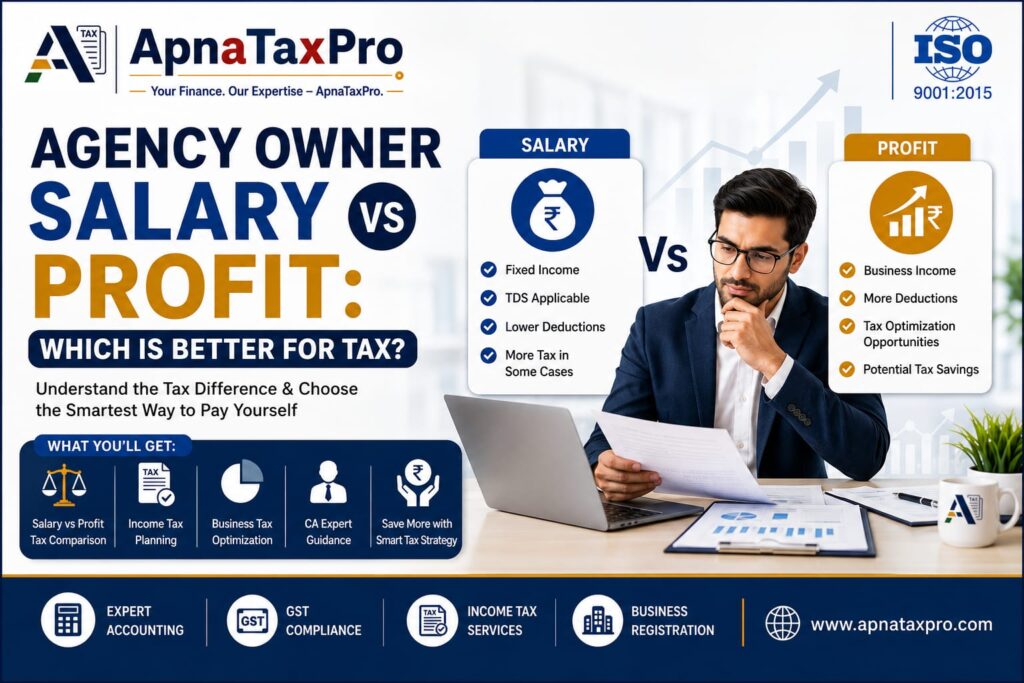
Many agency owners face the same question once their business starts generating consistent revenue:
Should I pay myself a salary or simply take money from the business profits?
Whether you run a digital marketing agency, creative agency, consulting firm, software development company, recruitment agency, or any other service business, your compensation structure directly impacts taxation, compliance, cash flow, and long-term financial planning.
A common mistake among growing businesses is treating business bank accounts like personal accounts. Owners often withdraw money whenever needed without understanding the tax implications. While this may seem convenient initially, it can create accounting complications, tax inefficiencies, and compliance risks later.
Understanding the difference between salary and profit withdrawals can help agency owners optimize taxes legally while maintaining proper financial records and business growth.
Let’s explore which approach makes more sense and when.
Understanding Salary and Profit
Before comparing tax implications, it’s important to understand the basic difference.
What Is Salary?
Salary is a fixed amount paid by a company to its owner or director for services rendered to the business.
For example:
- A director of a Private Limited Company receives a monthly salary.
- The salary is recorded as an expense in company books.
- TDS and payroll compliance may apply.
- The amount becomes taxable under personal income tax.
What Is Profit?
Profit is the surplus income remaining after all business expenses, taxes, and liabilities have been accounted for.
Owners may withdraw profits depending on the business structure:
- Proprietorship
- Partnership Firm
- LLP
- Private Limited Company (through dividends where applicable)
Profit withdrawals are treated differently from salary and may have separate tax implications.
Why This Decision Matters
The way you compensate yourself affects:
- Personal tax liability
- Business tax liability
- Cash flow
- Compliance requirements
- Loan eligibility
- Financial reporting
- Business valuation
A poorly structured compensation plan can result in paying more tax than necessary.
Salary vs Profit: Quick Comparison
| Particulars | Salary | Profit Withdrawal |
|---|---|---|
| Fixed Monthly Income | Yes | No |
| Business Expense | Yes (for companies) | No |
| Personal Tax Applicable | Yes | Depends on structure |
| Improves Personal Income Proof | Yes | Limited |
| Useful for Loans | High | Moderate |
| Compliance Requirement | Higher | Lower |
| Cash Flow Predictability | High | Variable |
| Tax Planning Flexibility | Moderate | High |
Tax Treatment Based on Business Structure
The answer depends largely on how your agency is registered.
Sole Proprietorship
If your agency operates as a sole proprietorship:
- You cannot legally pay yourself a salary.
- All business income is considered your personal income.
- Any withdrawal is treated as owner’s drawings.
- Tax is calculated on total business profit.
Example
Annual Agency Profit: ₹12,00,000
Whether you withdraw:
- ₹2,00,000
- ₹5,00,000
- ₹10,00,000
Your taxable income remains ₹12,00,000.
In this structure, salary vs profit is not a valid tax planning strategy because the owner and business are considered the same entity.
Partnership Firm
In a partnership firm, partners may receive:
- Remuneration
- Interest on capital
- Share of profit
The Income Tax Act provides specific rules regarding partner remuneration.
Important Point
Authorized partner remuneration may be allowed as a business expense subject to prescribed limits.
The share of profit received by partners is generally exempt in their hands after taxation at the firm level.
Proper structuring becomes important here.
LLP (Limited Liability Partnership)
Many agencies operate as LLPs due to compliance simplicity and flexibility.
In an LLP:
- Partners can receive remuneration.
- LLP profits are taxed at LLP level.
- Profit sharing generally remains exempt in partners’ hands.
Tax Planning Opportunity
A combination of:
- Reasonable partner remuneration
- Profit sharing
can often create a balanced tax structure.
However, calculations should always be reviewed by a tax professional.
Private Limited Company
For growing agencies, Private Limited Companies are common.
Owners can receive:
Director Salary
Advantages:
- Reduces company profit.
- Creates regular personal income.
- Helps with loan approvals.
- Provides structured compensation.
Disadvantages:
- Personal income tax applies.
- Payroll compliance required.
Dividends
Advantages:
- Flexibility in withdrawals.
- No payroll processing.
Disadvantages:
- Paid from post-tax profits.
- Dividend taxation applies in shareholders’ hands according to prevailing tax rules.
Which Option Is More Tax Efficient?
The answer is not always straightforward.
When Salary May Be Better
Salary may be beneficial when:
- You need regular monthly income.
- You are applying for loans.
- You need income proof.
- The company wants to reduce taxable profits.
- You prefer predictable cash flow.
When Profit Withdrawal May Be Better
Profit withdrawals may be suitable when:
- Business earnings fluctuate.
- You want flexibility.
- You already have other income sources.
- Business structure allows tax-efficient profit sharing.
Example: Agency Owner Tax Planning
Consider a Private Limited Company.
Scenario A: No Salary
Company Profit Before Tax: ₹24,00,000
The entire amount remains taxable in the company.
After taxes, profits can be distributed according to applicable rules.
Scenario B: Reasonable Director Salary
Director Salary: ₹9,00,000
Company Profit Reduces Accordingly.
Benefits:
- Lower company taxable profit.
- Regular personal income.
- Better documentation of compensation.
The optimal balance depends on:
- Total profits
- Applicable tax regime
- Other personal income
- Future growth plans
Professional tax planning is recommended before making decisions.
Common Mistakes Agency Owners Make
1. Mixing Personal and Business Expenses
Using business accounts for personal spending creates accounting confusion and weakens financial reporting.
Better Approach
Maintain separate:
- Business bank accounts
- Personal bank accounts
2. Taking Random Withdrawals
Frequent undocumented withdrawals can create bookkeeping issues.
Better Approach
Define a structured owner compensation policy.
3. Ignoring Tax Planning Until Year-End
Many business owners think about taxes only during return filing season.
Better Approach
Review tax planning quarterly.
4. Not Maintaining Proper Books
Without accurate accounting records, it becomes difficult to determine:
- Actual profits
- Tax liabilities
- Cash flow requirements
Professional bookkeeping is essential.
How Agency Owners Can Build a Smart Compensation Strategy
A balanced approach often works best.
Consider:
Step 1: Define Personal Income Needs
Calculate monthly living expenses.
Step 2: Maintain Emergency Business Cash
Avoid withdrawing all profits.
Step 3: Review Tax Position Quarterly
Monitor:
- Revenue
- Expenses
- GST compliance
- Advance tax requirements
Step 4: Use Financial Reporting
Monthly MIS reports help determine:
- Profitability
- Cash reserves
- Owner compensation capacity
Step 5: Consult Professionals
Tax planning should align with:
- Business goals
- Compliance obligations
- Growth strategy
Why Choose ApnaTaxPro?
Agency owners often need more than just tax filing. They need financial clarity and strategic guidance.
ApnaTaxPro helps businesses with:
- Accounting Services
- Bookkeeping Services
- GST Return Filing
- Income Tax Filing
- TDS Compliance
- Payroll Services
- ROC Compliance
- Startup Registration
- Company Registration
- LLP Registration
- MSME Consulting
- Financial Reporting
- Business Advisory
- Virtual CFO Services
Our team supports startups, agencies, SMEs, and growing businesses with practical financial management solutions. Whether you need Accounting Services in Indore, Bookkeeping Services in Indore, a GST Consultant in Indore, or a Tax Consultant in Indore, we help business owners make informed financial decisions backed by accurate reporting and compliance support.
Frequently Asked Questions (FAQs)
1. Can a sole proprietor take a salary from their own business?
No. A sole proprietor cannot draw salary from their own business. Withdrawals are treated as owner’s drawings.
2. Is salary tax deductible for a Private Limited Company?
Generally, director salary paid for genuine services can be treated as a business expense subject to applicable tax provisions.
3. Which is better for tax: salary or profit?
It depends on the business structure, income level, and tax situation of the owner.
4. Can LLP partners receive both salary and profit share?
Yes, subject to LLP agreement terms and applicable tax provisions.
5. Does salary reduce company profit?
Yes. Salary paid to directors or employees is generally recorded as a business expense.
6. Are dividends taxable?
Dividend taxation depends on prevailing income tax provisions and shareholder circumstances.
7. Why should agency owners maintain separate business accounts?
Separate accounts improve bookkeeping accuracy, compliance, and financial transparency.
8. How often should agency owners review tax planning?
Quarterly reviews are generally recommended to avoid year-end tax surprises.
Conclusion
The debate between salary and profit is not about choosing one universally better option. The right strategy depends on your business structure, profitability, growth plans, cash flow needs, and tax position.
For proprietors, profit remains the primary method of compensation. For LLPs and companies, a well-planned combination of salary, remuneration, and profit distribution can often create a more efficient structure.
The key is maintaining proper accounting records, understanding compliance requirements, and making informed decisions based on financial data rather than assumptions.
Call to Action
If you’re unsure whether salary, partner remuneration, or profit withdrawals are best for your agency, ApnaTaxPro can help. Our experts provide Accounting Services, Tax Planning, GST Compliance, Financial Reporting, and Virtual CFO Services to help business owners make smarter financial decisions.
Contact ApnaTaxPro today for professional guidance tailored to your business structure and growth goals.