
Published by ApnaTaxPro | GST Updates | July 2026
India’s GST compliance framework is taking another major leap towards automation.
From the July 2026 tax period, the GST Portal has introduced significant changes in the way GSTR-3B will be prepared and filed. Under the new mechanism, important details in GSTR-3B will be auto-populated based on GST records and certain fields will be locked, reducing the scope for manual corrections.
For many businesses, this may seem like a small technical update. However, in reality, it can directly impact Input Tax Credit (ITC), GST compliance, working capital, and even departmental notices if businesses are not prepared.
Whether you are a startup, MSME, trader, manufacturer, service provider, importer, exporter, LLP or Private Limited Company, understanding this update is no longer optional—it is essential.
At ApnaTaxPro, we have simplified the entire update so that every business owner can understand what is changing, why it matters, and how to stay fully GST compliant.
Why is GSTR-3B Changing?
The Government’s objective behind this update is simple—to improve the accuracy of GST returns and reduce manual reporting errors.
Earlier, taxpayers had greater flexibility while entering figures in GSTR-3B. This often resulted in mismatches between GSTR-1, GSTR-2B and GSTR-3B, leading to incorrect ITC claims, notices, and lengthy reconciliations.
With the new system, the GST portal aims to ensure that returns are prepared using data already available on the portal, making GST filing more transparent and reducing compliance risks.
What Has Changed in GSTR-3B?
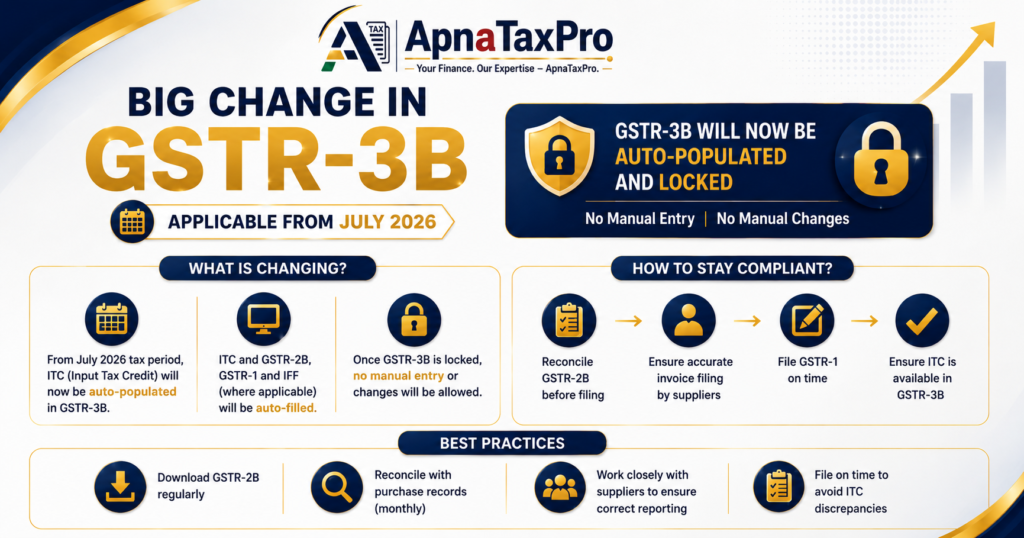
From the July 2026 tax period, GSTR-3B will rely much more heavily on data already available within the GST system.
This means that eligible Input Tax Credit (ITC) and several return values will be automatically populated using information available from GSTR-1, GSTR-2B and IFF (where applicable). Once these values are generated and locked by the portal, taxpayers will not be able to freely modify the specified fields.
Simply put, businesses can no longer depend on last-minute manual adjustments while filing GSTR-3B. The accuracy of earlier GST filings and vendor reporting will now play a much bigger role in determining the correctness of the final return.
How Will This Impact Businesses?
The biggest impact will be on businesses that do not reconcile their GST data regularly.
If a supplier delays filing GSTR-1 or uploads incorrect invoices, those transactions may not reflect correctly in your GSTR-2B. As a result, your eligible ITC may also be affected, increasing your GST liability and impacting cash flow.
Similarly, businesses maintaining inaccurate books of accounts or delaying purchase reconciliations may face unnecessary mismatches, notices, or compliance issues.
The message is clear—GST compliance is no longer just about filing returns on time; it is about filing accurate returns every month.
What Should Businesses Do Now?
Instead of waiting until the due date, businesses should adopt a proactive compliance process.
Every month, download GSTR-2B, reconcile it with your purchase register, verify invoices uploaded by suppliers, and ensure GSTR-1 is filed accurately and within the prescribed timelines. Regular communication with vendors is equally important because your ITC now depends not only on your compliance but also on theirs.
Businesses using accounting software should also ensure that their books are updated in real time and that every GST transaction is properly recorded before filing returns.
How ApnaTaxPro Helps Businesses Stay Ahead
Keeping track of every GST notification, amendment, and compliance requirement can be challenging for business owners. That’s where ApnaTaxPro comes in.
Our team of GST professionals helps businesses with complete GST compliance—from registration to return filing, reconciliation, notice handling, amendments, cancellation, accounting, bookkeeping, and Virtual CFO services.
Before every GST filing, we perform detailed reconciliation of GSTR-2B with purchase records, identify mismatches, coordinate with clients for corrections, and ensure that returns are filed accurately and on time.
Our goal is simple: help businesses maximize eligible ITC, avoid GST notices, and remain fully compliant with the latest government regulations.
Why Choose ApnaTaxPro?Businesses across India trust ApnaTaxPro because we focus on accuracy, transparency, and timely compliance.
Whether you need GST Registration, GST Return Filing, Company Registration, LLP Registration, Income Tax Filing, Accounting & Bookkeeping, MSME Registration, Startup Compliance, or Virtual CFO Services, our experienced professionals provide end-to-end support under one roof.
If you are searching for the Best GST Consultant in Indore, Best GST Services in Indore, Best Accounting Firm in Indore, Company Registration in Indore, or a reliable tax advisor for your growing business, ApnaTaxPro is committed to delivering professional, technology-driven, and affordable solutions.
Final Thoughts
The new GSTR-3B auto-populated and locked return system is more than just another GST update—it represents a significant shift in how businesses will manage GST compliance in the future.
Businesses that maintain accurate books, reconcile data regularly, and file returns on time will benefit from smoother compliance and fewer disputes. Those relying on manual adjustments or delayed reconciliations may face avoidable challenges.
This is the right time to review your GST processes and ensure your business is ready for the new compliance framework.
Need expert GST assistance? Connect with ApnaTaxPro today and let our GST specialists help you stay compliant, protect your Input Tax Credit, and file every GST return with confidence.