
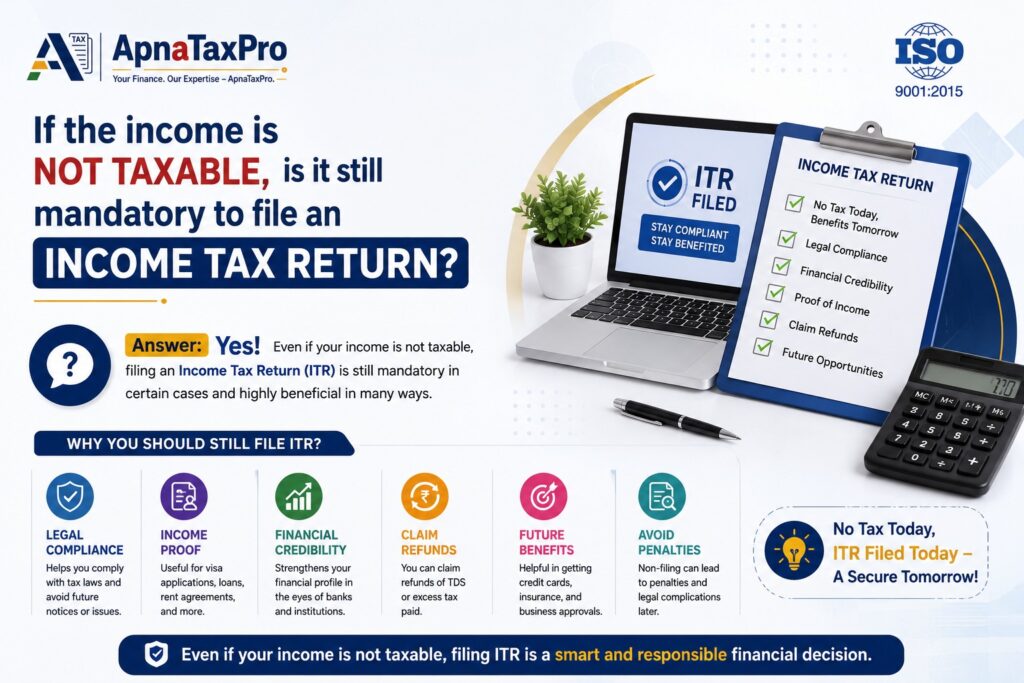
Imagine you are a salaried employee, freelancer, or small business owner whose annual income is below the basic exemption limit. Since no income tax is payable, you may wonder whether filing an Income Tax Return (ITR) is necessary.
This is one of the most common questions taxpayers ask every year. Many people assume that if they do not owe any tax, filing an ITR is unnecessary. While that may be true in some situations, there are several important exceptions and practical reasons why filing an ITR can still be beneficial.
In this guide, we explain when ITR filing is mandatory, when it is optional, and why voluntarily filing your return can help you in the future.
What Is an Income Tax Return (ITR)?
An Income Tax Return (ITR) is a form submitted to the Income Tax Department that reports your income, deductions, taxes paid, and tax liability for a financial year.
It serves as an official record of your financial income and tax compliance.
Is Filing an ITR Mandatory If Your Income Is Below the Taxable Limit?
The answer is:
Not always.
If your total income is below the basic exemption limit and you do not meet any other mandatory filing conditions, filing an ITR is generally not compulsory.
However, there are important exceptions where filing becomes mandatory regardless of your taxable income.
Basic Exemption Limits
| Category | Basic Exemption Limit |
|---|---|
| Individual (Generally) | As per applicable tax regime and Finance Act provisions for the relevant assessment year |
| Senior Citizen | Applicable limits as notified |
| Super Senior Citizen | Applicable limits as notified |
Always refer to the latest provisions applicable for your assessment year before deciding whether filing is mandatory.
Situations Where Filing an ITR Is Mandatory Even If Income Is Not Taxable
1. High-Value Financial Transactions
You may need to file an ITR if you have carried out certain specified high-value transactions, such as:
- Large cash deposits in bank accounts
- Significant current account deposits
- High expenditure on foreign travel
- High electricity consumption
- Other prescribed financial transactions reported to the Income Tax Department
2. Foreign Assets or Foreign Income
If you are a resident and own:
- Foreign bank accounts
- Foreign investments
- Foreign property
- Foreign income
ITR filing may become mandatory even if your taxable income is nil.
3. Business or Professional Income
Business owners, professionals, consultants, and freelancers often benefit from filing ITR even when their profits are low because it establishes financial credibility and maintains proper compliance.
4. TDS Has Been Deducted
Suppose your bank deducted TDS on Fixed Deposit interest.
Even though your income is below the taxable limit, filing an ITR allows you to claim a refund of the excess tax deducted.
5. Loss Carry Forward
If you have:
- Business losses
- Capital losses
- Certain other eligible losses
Filing the return within the prescribed due date is generally required to carry forward those losses for adjustment in future years.
When Filing an ITR Is Optional
Generally, filing may be optional if:
- Income is below the exemption limit.
- No mandatory filing condition applies.
- No foreign assets or foreign income exist.
- No refund is due.
- No loss needs to be carried forward.
Even then, many taxpayers choose to file voluntarily because of the long-term advantages.
Benefits of Filing an ITR Even If No Tax Is Payable
Builds Financial Credibility
Banks and financial institutions often ask for ITR copies when processing:
- Home loans
- Personal loans
- Business loans
- Vehicle loans
A consistent ITR filing history strengthens your financial profile.
Easier Visa Processing
Many embassies require ITR acknowledgements while processing visa applications.
Regular filing demonstrates financial stability and genuine income.
Claim Tax Refunds
If excess TDS has been deducted by:
- Employer
- Bank
- Customer
- Client
You can recover the amount only by filing your Income Tax Return.
Proof of Income
ITR acts as a reliable income proof for:
- Government tenders
- Financial institutions
- Educational applications
- Property purchases
- Insurance claims
Smooth Future Tax Compliance
Even when income increases in future years, your tax history remains well documented.
This helps reduce compliance issues.
Practical Example
Example 1
Rahul earns ₹2.8 lakh annually from freelancing.
No TDS has been deducted.
He has no foreign assets.
In this situation, filing an ITR may not be mandatory.
Example 2
Priya earns ₹2.9 lakh.
Her bank deducted ₹12,000 as TDS on Fixed Deposit interest.
By filing an ITR, she can claim a refund of ₹12,000.
Example 3
A startup founder reports a business loss in the first year.
Although no tax is payable, filing the return on time helps preserve eligible losses for future tax adjustments.
Common Misconceptions About ITR Filing
| Myth | Reality |
|---|---|
| No tax means no ITR | Not always true |
| Only salaried employees file ITR | Businesses, freelancers, professionals and investors also file |
| Filing ITR increases tax scrutiny | Genuine and accurate filing supports compliance |
| ITR is needed only for tax payment | It also serves as financial proof |
Who Should Consider Filing an ITR Voluntarily?
You should strongly consider filing if you are:
- Salaried employee
- Freelancer
- Consultant
- Small business owner
- Startup founder
- Professional
- Investor
- Pensioner
- MSME owner
- Trader
- Manufacturer
- Service provider
Checklist Before Deciding
Ask yourself:
- Is my income below the exemption limit?
- Was any TDS deducted?
- Do I need a tax refund?
- Will I apply for a loan?
- Will I apply for a visa?
- Do I have foreign assets?
- Do I want to carry forward losses?
- Have I completed any specified high-value financial transactions?
If you answered “Yes” to any of these, filing an ITR may be advisable—or required.
Why Choose ApnaTaxPro?
Income tax laws continue to evolve, and determining whether you need to file an ITR can sometimes be more complex than simply checking your income level. At ApnaTaxPro, we help individuals, startups, MSMEs, and businesses understand their compliance responsibilities and make informed financial decisions.
Our professional services include:
- Income Tax Return Filing
- Accounting Services
- Bookkeeping Services
- GST Registration and GST Return Filing
- TDS Compliance
- Payroll Services
- Business Registration
- Company Registration
- ROC Compliance
- Virtual CFO Services
- Financial Reporting
- Business Advisory
- Startup Consulting
If you are looking for Accounting Services in Indore, Bookkeeping Services in Indore, GST Consultant in Indore, or a trusted Tax Consultant in Indore, our team provides practical, compliance-focused support tailored to your business needs.
Frequently Asked Questions (FAQs)
1. Can I file an ITR if my income is below the taxable limit?
Yes. Voluntary filing is permitted and often beneficial.
2. Will I get a refund if TDS was deducted?
Yes, provided you file your Income Tax Return and are eligible for the refund.
3. Is ITR required for a bank loan?
Many banks request ITR copies while evaluating loan applications.
4. Can freelancers file ITR even with low income?
Yes. Filing helps maintain financial records and supports future business growth.
5. Is filing an ITR compulsory for pensioners?
It depends on total income and applicable filing conditions.
6. Can ITR help in visa applications?
Yes. Many countries consider ITR acknowledgements as supporting financial documents.
7. What happens if I do not file when filing is mandatory?
You may face penalties, interest, or other consequences under the Income-tax Act, depending on the circumstances.
8. How can ApnaTaxPro help?
We assist with tax planning, ITR filing, refunds, notices, GST, accounting, compliance, and business advisory.
Conclusion
Having income below the taxable limit does not automatically mean that filing an Income Tax Return is unnecessary. While many individuals may not be legally required to file, doing so can provide valuable financial benefits, including easier loan approvals, visa support, refund claims, and stronger financial documentation.
Before deciding to skip ITR filing, review whether any mandatory filing conditions apply to you. A timely and accurate return can save you from future compliance issues and help build a reliable financial record.
Call to Action
Not sure whether you need to file an ITR this year?
ApnaTaxPro offers professional assistance with Income Tax Return Filing, GST compliance, accounting, bookkeeping, payroll, business registration, and financial advisory. Whether you’re an individual, freelancer, startup, or business owner, our experts can help you meet your tax obligations with confidence.
Contact ApnaTaxPro today to determine your ITR filing requirements and ensure hassle-free tax compliance.