
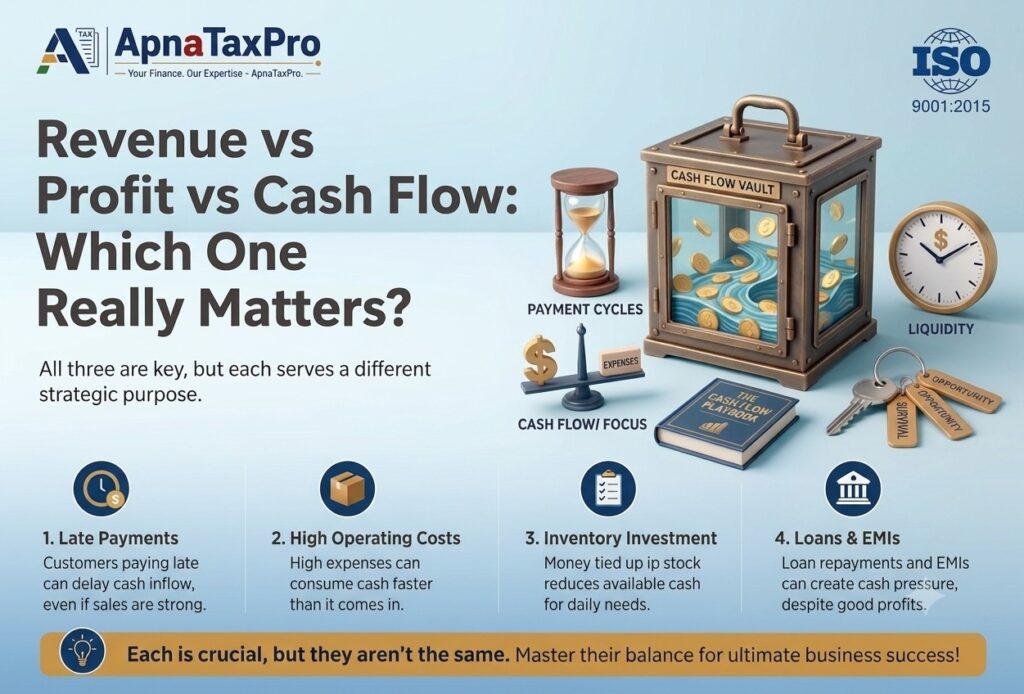
Many business owners believe that increasing sales automatically means business success. However, there are countless businesses that generate high revenue but still struggle to pay salaries, vendor bills, GST liabilities, and operating expenses on time.
Imagine a business that records ₹1 crore in annual sales. On paper, the numbers look impressive. Yet, the owner constantly faces cash shortages and struggles to manage daily operations. Why does this happen?
The answer lies in understanding three critical financial metrics: Revenue, Profit, and Cash Flow.
While these terms are often used interchangeably, they represent very different aspects of business performance. Understanding the difference can help business owners make smarter financial decisions, improve sustainability, and avoid unnecessary financial stress.
In this guide, we’ll explain Revenue vs Profit vs Cash Flow in simple language and help you understand which one really matters for your business.
What is Revenue?
Revenue is the total income generated from selling products or services before deducting any expenses.
It is often called the “top line” because it appears at the top of the Profit & Loss Statement.
Example
A manufacturing company sells goods worth ₹10,00,000 during a month.
Revenue = ₹10,00,000
This amount represents total sales but does not indicate whether the business is making money.
Why Revenue Matters
Revenue helps businesses:
- Measure sales performance
- Track growth trends
- Evaluate market demand
- Set business targets
- Attract investors
However, revenue alone does not reveal the actual financial health of a business.
What is Profit?
Profit is the amount remaining after deducting all business expenses from revenue.
Formula
Profit = Revenue – Expenses
Expenses may include:
- Salaries
- Rent
- Utilities
- Raw materials
- Marketing costs
- Professional Tax
- GST-related expenses
- Administrative expenses
Example
Revenue: ₹10,00,000
Expenses: ₹8,00,000
Profit: ₹2,00,000
In this scenario, the business has earned a profit of ₹2,00,000.
Types of Profit
Gross Profit
Revenue minus direct production costs.
Operating Profit
Profit after operational expenses.
Net Profit
Final profit after all expenses and taxes.
Net profit is often considered the most important profitability indicator for business owners.
What is Cash Flow?
Cash flow refers to the actual movement of money into and out of a business.
It shows whether a company has enough cash available to meet day-to-day obligations.
Many profitable businesses fail because they run out of cash.
Example
Suppose you issue an invoice worth ₹5,00,000 to a customer with a 90-day payment term.
Revenue = ₹5,00,000
Profit may also be recorded.
But until the customer pays, there is no actual cash received.
This creates a cash flow gap.
Positive Cash Flow
When cash inflows exceed cash outflows.
Negative Cash Flow
When expenses exceed available cash.
Negative cash flow can create serious operational challenges even when revenue and profit appear healthy.
Revenue vs Profit vs Cash Flow: Comparison Table
| Metric | Revenue | Profit | Cash Flow |
|---|---|---|---|
| Meaning | Total sales income | Income after expenses | Actual cash movement |
| Indicates | Business size | Business profitability | Financial stability |
| Appears In | Income Statement | Income Statement | Cash Flow Statement |
| Includes Credit Sales | Yes | Yes | No |
| Helps Measure | Growth | Efficiency | Liquidity |
| Most Useful For | Sales analysis | Performance analysis | Survival and operations |
Which One Really Matters?
The truth is that all three metrics matter, but their importance differs depending on business goals.
When Revenue Matters Most
Revenue becomes important when:
- Measuring business growth
- Expanding market share
- Attracting investors
- Evaluating sales performance
High revenue demonstrates demand for your products or services.
When Profit Matters Most
Profit becomes important when:
- Measuring business efficiency
- Evaluating sustainability
- Planning expansion
- Determining owner returns
A company cannot survive long-term without profitability.
When Cash Flow Matters Most
Cash flow becomes critical when:
- Paying salaries
- Managing GST liabilities
- Purchasing inventory
- Paying suppliers
- Managing loans
A business can survive temporary losses but cannot survive without cash.
Why Many Businesses Focus on the Wrong Metric
Many entrepreneurs focus only on sales growth.
However, revenue growth without proper ACCOUNTING and BOOKKEEPING can create financial problems.
Common mistakes include:
- Offering excessive credit to customers
- Ignoring cash flow planning
- Poor account and records management
- Delayed GST Registration and compliance
- Lack of financial reporting
- Not reviewing profitability regularly
Professional Accounting Services help businesses monitor all three metrics simultaneously.
Practical Scenario: Understanding the Difference
Consider two businesses.
Business A
- Revenue: ₹1 Crore
- Profit: ₹5 Lakh
- Cash Flow: Negative
Business B
- Revenue: ₹60 Lakh
- Profit: ₹12 Lakh
- Cash Flow: Positive
Which business is healthier?
In many cases, Business B may be financially stronger because it generates higher profits and maintains positive cash flow.
This example shows why revenue alone does not determine business success.
How to Improve Revenue, Profit, and Cash Flow
Improve Revenue
- Expand customer base
- Increase pricing strategically
- Launch new products
- Improve marketing efforts
- Target nearby SMEs companies
Improve Profit
- Reduce unnecessary expenses
- Improve operational efficiency
- Negotiate better supplier pricing
- Automate repetitive processes
- Optimize tax planning
Improve Cash Flow
- Follow up on receivables
- Reduce payment delays
- Maintain emergency reserves
- Monitor monthly cash flow reports
- Use professional financial reporting systems
The Role of Accounting and Financial Reporting
Accurate ACCOUNTING AND financial reporting provide visibility into revenue, profit, and cash flow.
Without proper records, business owners often make decisions based on assumptions rather than facts.
Professional ACCOUNT AND RECORDS management helps businesses:
- Track profitability
- Manage taxes
- Improve compliance
- Monitor cash flow
- Support business growth
Whether you’re searching for an ACCOUNTANT OFFICE NEAR ME or looking for outsourced accounting support, maintaining accurate financial records is essential.
Why Choose ApnaTaxPro?
APNA TAX PRO helps businesses make informed financial decisions through professional Accounting Services and Business Advisory solutions.
Our services include:
- ACCOUNTING Services
- BOOKKEEPING Services
- GST Registration
- GST Return Filing
- Income Tax Filing
- Professional Tax Compliance
- Payroll Services
- ROC Compliance
- Virtual CFO Services
- Financial Reporting
- Startup Registration
- New Company Registration in Indore
- Gumasta Udyham Registration Support
- Business Compliance Consulting
As a trusted provider of Accounting Services in Indore, Bookkeeping Services in Indore, GST Consultant in Indore, and Tax Consultant in Indore solutions, we help businesses understand their numbers and improve financial performance.
Whether you are a startup, MSME, trader, manufacturer, freelancer, or service provider, our experts help transform financial data into actionable business insights.
Frequently Asked Questions
1. What is the main difference between revenue and profit?
Revenue is total sales income, while profit is the amount left after deducting expenses.
2. Can a business be profitable but have cash flow problems?
Yes. Delayed customer payments often create cash flow issues despite profitability.
3. Why is cash flow important?
Cash flow ensures a business can pay employees, suppliers, taxes, and operating expenses on time.
4. Which metric do investors focus on?
Investors typically analyze revenue growth, profitability, and cash flow together.
5. How often should businesses review financial reports?
Monthly reviews are recommended for better financial control.
6. What role does bookkeeping play in cash flow management?
Bookkeeping helps track receivables, payables, and available cash balances accurately.
7. How can Virtual CFO Services help?
Virtual CFO Services provide strategic financial planning, reporting, forecasting, and business advisory support.
8. Why should startups monitor revenue, profit, and cash flow?
Monitoring all three helps startups avoid financial surprises and achieve sustainable growth.
Conclusion
Revenue, profit, and cash flow are all important, but they serve different purposes.
Revenue shows business growth.
Profit shows business efficiency.
Cash flow shows business survival capability.
A successful business balances all three metrics. Focusing only on sales without monitoring profitability and liquidity can create serious financial challenges.
The smartest business owners use accurate accounting, bookkeeping, financial reporting, and cash flow management to make informed decisions and build long-term success.
Call to Action
Want better control over your business finances?
Whether you need Accounting Services, Bookkeeping Services, GST Registration, GST Return Filing, Virtual CFO Services, Financial Reporting, or New Company Registration in Indore, ApnaTaxPro can help.
Contact ApnaTaxPro today and gain complete clarity on your Revenue, Profit, and Cash Flow.