
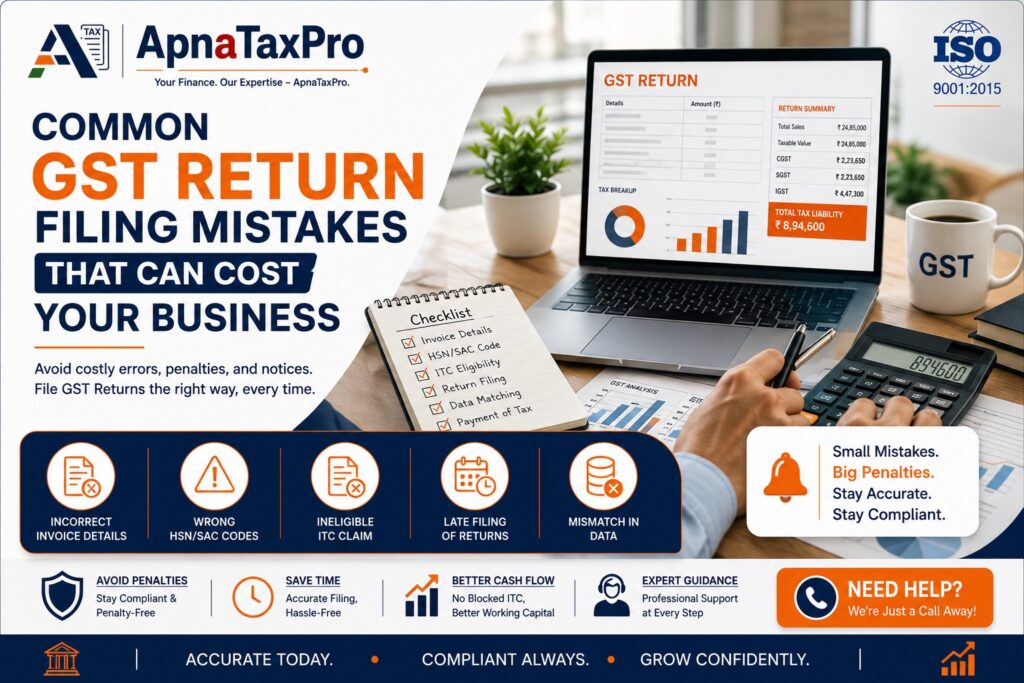
GST compliance has become an essential part of running a business in India. Whether you are a startup, trader, manufacturer, freelancer, or service provider, filing GST returns accurately and on time is not just a legal requirement—it directly impacts your cash flow, Input Tax Credit (ITC), and business reputation.
Many business owners assume that GST return filing is only about uploading invoices before the due date. However, even a small mistake such as selecting the wrong GST rate, missing an invoice, or claiming incorrect Input Tax Credit can lead to notices, penalties, blocked ITC, and unnecessary financial stress.
These mistakes are surprisingly common and often happen because of poor bookkeeping, incomplete accounting records, lack of reconciliation, or misunderstanding of GST provisions.
In this guide, we’ll discuss the most common GST return filing mistakes, their business impact, and practical steps to avoid them.
Why GST Return Accuracy Matters
GST is a technology-driven tax system where data is automatically matched between suppliers and buyers. Every invoice you upload affects both your business and your customer’s tax credit.
Incorrect GST filing may result in:
- Delayed Input Tax Credit
- Interest on tax liability
- GST notices
- Penalties
- Additional compliance costs
- Business credibility issues
- Cash flow problems
For growing businesses, maintaining proper Accounting, Bookkeeping, Account and Records, and timely GST compliance is essential.
1. Filing GST Returns After the Due Date
Late filing remains one of the most common GST compliance mistakes.
Business Impact
- Late fees
- Interest on unpaid tax
- Delayed ITC for customers
- Compliance rating may be affected
- Increased chances of receiving GST notices
Best Practice
Create a monthly compliance calendar and maintain updated accounting records throughout the month instead of waiting until the due date.
2. Claiming Incorrect Input Tax Credit (ITC)
Many businesses claim ITC without verifying supplier invoices or ensuring that suppliers have filed their GST returns.
Common Reasons
- Supplier has not filed GSTR-1
- Invoice mismatch
- Wrong GSTIN
- Duplicate invoices
- Fake or invalid invoices
Solution
Always reconcile:
- Purchase Register
- GSTR-2B
- Vendor invoices
- Accounting software records
Monthly reconciliation significantly reduces GST notices.
3. Incorrect GSTIN Entry
A single digit mistake while entering a customer’s GSTIN can create serious reconciliation issues.
Example
Instead of billing:
27ABCDE1234F1Z5
You accidentally enter:
27ABCDE1234F1Z8
Result:
- Customer cannot claim ITC.
- Invoice mismatch occurs.
- Revision becomes necessary.
Always verify GSTIN before invoice generation.
4. Wrong GST Rate Selection
Many businesses accidentally apply:
- 5% instead of 12%
- 12% instead of 18%
- Wrong HSN classification
This leads to:
- Short payment of tax
- Excess payment
- GST notices
- Additional interest
Always verify HSN codes and applicable GST rates before invoicing.
5. Ignoring Reconciliation Before Filing Returns
Many businesses directly upload returns without checking accounting records.
Reconciliation Should Include
- Sales Register
- Purchase Register
- Bank Transactions
- GSTR-1
- GSTR-3B
- GSTR-2B
- E-way Bills (where applicable)
This simple monthly process prevents most GST errors.
6. Maintaining Poor Account and Records
GST compliance starts with proper documentation.
Businesses that fail to maintain complete Account and Records often struggle during:
- GST Audit
- Department notices
- Income Tax assessments
- Loan applications
- Due diligence
Maintain proper:
- Sales invoices
- Purchase invoices
- Expense bills
- Bank statements
- Debit/Credit Notes
- Stock records
Strong Accounting and Bookkeeping practices make GST filing easier and more accurate.
7. Missing Reverse Charge Transactions
Businesses sometimes ignore transactions covered under Reverse Charge Mechanism (RCM).
Examples include certain legal services, transport services, or notified supplies.
Failure to report RCM correctly can result in:
- Interest
- Penalties
- Incorrect tax liability
Review vendor transactions carefully every month.
8. Not Updating Business Changes
Businesses often forget to update GST records after:
- Address change
- New business location
- Additional place of business
- Business name change
- New partners/directors
Update your GST Registration whenever business details change to avoid future complications.
9. Poor Bookkeeping Throughout the Year
Many business owners complete bookkeeping only at year-end.
This creates:
- Missing invoices
- Wrong expense classification
- Incorrect GST reporting
- Delayed return filing
Regular Bookkeeping Services ensure accurate financial reporting and timely GST compliance.
10. Depending Entirely on Manual Work
Manual spreadsheets increase the risk of:
- Duplicate invoices
- Calculation mistakes
- Missing entries
- Incorrect tax computation
Using professional accounting software with expert review significantly reduces errors.
Comparison Table: Common GST Mistakes vs Their Impact
| GST Mistake | Business Impact | Recommended Solution |
|---|---|---|
| Late Return Filing | Interest & Penalty | Monthly Compliance Calendar |
| Wrong ITC Claim | GST Notice | Monthly Reconciliation |
| Wrong GST Rate | Tax Demand | Verify HSN Codes |
| Incorrect GSTIN | ITC Block | Validate GSTIN |
| Poor Bookkeeping | Compliance Issues | Professional Bookkeeping |
| Missing RCM | Interest | Vendor Review |
| Unmatched Returns | Notice | GSTR Reconciliation |
| Incomplete Records | Audit Problems | Maintain Proper Documentation |
Practical GST Filing Checklist
Before filing every GST return:
✔ Verify Sales Register
✔ Verify Purchase Register
✔ Match GSTR-2B
✔ Verify GSTIN
✔ Check HSN Codes
✔ Verify Tax Rates
✔ Review ITC
✔ Check RCM Transactions
✔ Reconcile Books
✔ File Before Due Date
Why Professional GST Compliance Matters
Many business owners spend hours trying to understand GST rules, while missing important business opportunities.
Professional GST compliance helps businesses:
- Save time
- Reduce penalties
- Improve cash flow
- Maintain proper accounting records
- Ensure accurate GST filing
- Prepare financial reports
- Improve business decision-making
Why Choose ApnaTaxPro
At ApnaTaxPro , we help startups, MSMEs, traders, manufacturers, freelancers, and growing businesses manage their financial compliance with confidence.
Our services include:
- Accounting Services
- Bookkeeping Services
- Professional Tax Support
- GST Return Filing
- GST Registration
- Income Tax Filing
- TDS Compliance
- Payroll Services
- Business Compliance
- Financial Reporting
- Virtual CFO Services
- Business Advisory
- ROC Compliance
- Startup Registration
- Company Registration
- New Company Registration in Indore
- Gumasta Registration
- Udyam (MSME) Registration
- Accounting and Financial Consulting
Whether you’re searching for an Accountant Office Near Me, a reliable GST Filing Company, or expert Accounting Services in Indore, ApnaTaxPro provides practical, timely, and compliance-focused solutions tailored to your business needs. We also assist nearby SMEs companies with end-to-end compliance and advisory services.
Frequently Asked Questions (FAQs)
1. What is the most common GST return filing mistake?
Late filing, incorrect Input Tax Credit claims, and invoice mismatches are among the most common mistakes.
2. Can incorrect GST filing lead to penalties?
Yes. Errors may result in interest, penalties, GST notices, and delayed Input Tax Credit.
3. Why is bookkeeping important for GST compliance?
Proper bookkeeping ensures accurate invoices, correct tax calculations, and smooth reconciliation before filing returns.
4. How often should GST reconciliation be done?
Monthly reconciliation is recommended to identify and correct errors before filing returns.
5. What documents are required for GST return filing?
Sales invoices, purchase invoices, expense bills, bank statements, debit/credit notes, and accounting records.
6. Should startups hire a GST consultant?
Yes. A GST consultant helps startups avoid compliance mistakes and maintain accurate records from day one.
7. Is GST registration mandatory for every business?
It depends on turnover, business type, and applicable GST provisions. Businesses meeting the eligibility criteria must obtain GST registration.
8. How can ApnaTaxPro help my business?
ApnaTaxPro offers Accounting Services, Bookkeeping, GST Registration, GST Return Filing, Income Tax, Payroll, ROC Compliance, Virtual CFO Services, and Business Advisory to help businesses stay compliant and grow efficiently.
Conclusion
GST return filing is more than a monthly compliance activity—it reflects the financial discipline of your business. Simple mistakes such as delayed filing, incorrect ITC claims, poor bookkeeping, or inaccurate records can lead to penalties, notices, and cash flow issues.
By maintaining proper accounting practices, reconciling records regularly, and seeking professional guidance when needed, businesses can significantly reduce compliance risks and focus on sustainable growth.
Call to Action
Need help with GST Return Filing, Accounting Services, Bookkeeping, GST Registration, Income Tax, Payroll, ROC Compliance, or Virtual CFO Services?
ApnaTaxPro supports startups, MSMEs, traders, manufacturers, and service providers with reliable compliance and financial advisory services. Contact our team today to ensure your GST returns are accurate, timely, and fully compliant.